
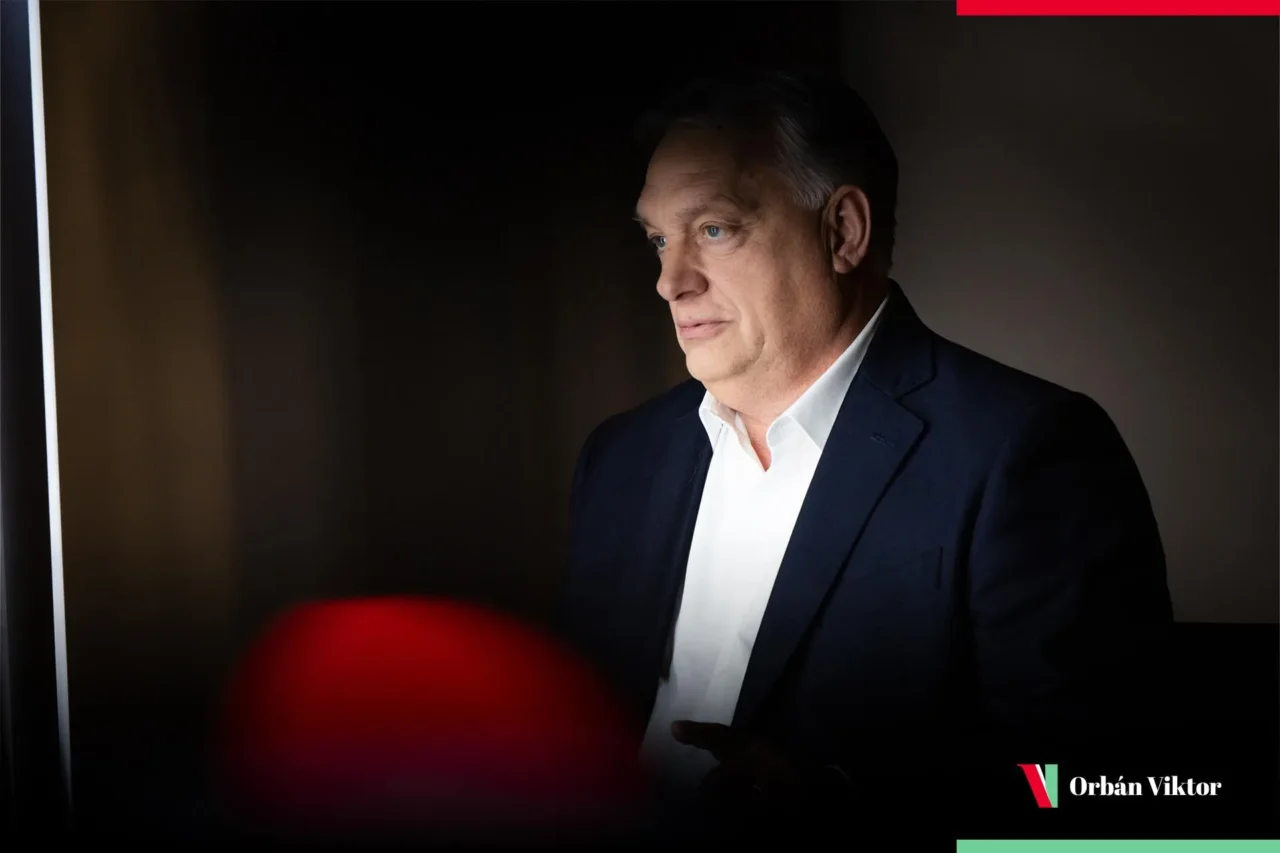
Hungary’s leadership has been calling for deep reforms to the bloc, but does the country have any intention of quitting the European Union? Prime Minister Viktor Orbán made his position clear in a wide-ranging interview published on Saturday. Speaking to Mathias Döpfner, CEO of the Axel Springer media group, Orbán said Hungary remains firmly part of Western Christian civilisation, even though he believes the EU has “drifted from a peace project to a war project”.
The interview, released on Döpfner’s YouTube channel, touched on topics from the EU’s future to the war in Ukraine, US politics and Hungary’s security strategy. Orbán repeated his view that Hungary’s political system is one of the “most stable and effective” in Europe and insisted that democratic governance must be built on freedom.
“Hungary will never leave the EU”
According to Orbán, Brussels seeks to reshape Hungary’s political leadership, but Budapest’s aim is reform, not departure.
“Hungary wants to reform the EU, but it will never leave it,” he said, adding that national sovereignty remains the most important European value.
Orbán argued that the current institutional setup “does not work” and that a new structure is needed to allow member states to cooperate more effectively. He believes “patriots” should lead this shift. Europe, he added, is undermining its own competitiveness — something he described as a major disappointment.
Asked about the central theme of the next Hungarian election campaign, Orbán did not hesitate: sovereignty. He also claimed that his modern Christian government faces challengers “financed and sustained in Brussels”.
Migration and sovereignty
On migration, the prime minister reiterated that Hungary must retain the right to decide “who enters the country and with whom Hungarians want to live”. Allowing large numbers of non-Christians into a Christian country “affects democracy itself”, he argued. He repeated his long-standing position that Hungary stopped illegal migration — and was “punished” by Brussels for doing so.
Orbán also noted that Hungary employs guest workers, but said this differs from mass migration flows.
Orbán: “We are very close to peace in Ukraine”
Turning to the war in Ukraine, Orbán claimed that Europe is “very close to peace”, provided there is a unified transatlantic position. He criticised the EU’s large financial support for Ukraine, calling it unrealistic to fund a country that “will not win the war” and is “highly corrupt”, while Europe lacks resources to strengthen its competitiveness.
He argued that a joint European–American stance would also ease future trade negotiations.
Trump praised as “a man of peace”
Orbán once again expressed strong admiration for Donald Trump, calling the US president “a man of peace”.
He suggested that if Trump had been president at the start of the Ukraine war, it “probably would not have broken out” or would have ended quickly. He highlighted Trump’s Christian worldview and said he had recognised already in 2015 that “the Western world needs Trump”.
Orbán added that he fully supports Trump’s peace efforts in the Gaza Strip.
Russia, NATO and the risk of escalation
Asked whether President Vladimir Putin is interested in a ceasefire and peace, Orbán said yes. At the same time, he dismissed as “ridiculous” the idea that Russia might attack an EU or NATO member state, arguing that Moscow “is not strong enough” for such a move.
However, he warned that continued escalation increases the risk of a third world war.
“We must demonstrate our strength at the negotiating table, not on the front line,” he said.
Orbán said Europe should emerge from the war with a stronger security system, adding that Hungary’s security is shaped by a “Berlin–Moscow–Istanbul triangle”.
He claimed that the longer the conflict lasts, the stronger Russia becomes — and argued that Hungary, with its long historical experience of Russia, could play a valuable mediating role.
On Germany, the AfD, and war rhetoric
Orbán expressed surprise at what he called the normalisation of “war talk” in German politics. He added that the war would not have started if Angela Merkel had still been chancellor, and stated: “Without Germany, Europe will never be pro-peace.”
He also spoke positively about Alice Weidel, co-leader of the far-right Alternative for Germany (AfD), saying her recent visit to Budapest left a strong impression on him, especially her economic proposals.
Oil sanctions, US nuclear technology, and Europe’s financial “shield”
Orbán confirmed that Hungary has an exemption from US sanctions on Russian oil exports — and that he and Trump agreed this would remain in place as long as both leaders hold office. He said he explained to Trump that losing access to Russian oil would trigger “immediate, multiple price increases” and devastate millions of households in a landlocked country with no alternatives.
He also noted that Germany received a similar exemption before Hungary.
On economic security, Orbán said Hungary has historically been financially vulnerable since the post-First World War settlement stripped away its economic foundations. According to him, the EU should provide a financial “shield”, but instead, Brussels is “blackmailing” and “strangling” Hungary economically.
“This shield is now needed against Brussels,” Orbán declared.
Finally, he said Hungary is in talks with the US to purchase nuclear technology, arguing that the country lacks natural resources and therefore must rely heavily on nuclear energy — potentially covering 70% of its future energy needs.



The biggest lie Orban put out is that the invader Russia desires a ceasefire and peace. He is pushing Kremlin propaganda to turn Hungarian fools into little Russians.
Orbán lies as he breathes, unbelievable!
Victor Mihaly. Orban – at “Super Sonic” speed continues to EXHIBIT that he FEAR’s truth.
Truth is Truth, and throughout, even prior to Orban’s entry into Political life, in his FABRICATION of existence, what REALLY is HIM, the word TRUTH has been dismissive in his being.
Victor Mihaly. Orban has FAILED Hungarians in millions upon millions and Failed Humiliated respect and trust in the name of our country Hungary.
Victor Mihaly. Orban – his Fidesz Government, in the (16) sixteen years as the Government of Hungary through FEAR of Truth have DELIVERED Hungary destroyed friendships and relationships with country’s that we Hungary had for centuries predominantly those in Europe, in the European Union and Globally that are Governed under or “in respect” of DEMOCRACY.
Victor Mihaly. Orban and his Fidesz Government – have “Sold us Out” – betrayed Hungarians – Hungary.
WHAT have we been DELIVERED ?
What have we to look forward to – the FUTURE of Hungary ?
Nothing, absolutely NOTHING, nothing can be PROVIDED to the FUTURE of Hungary under the name of Victor Mihaly. Orban – Fidesz.
Hungarians our country Hungary – we have been FAILED .
Yes and no, Dear Larry.
Yes, Russia wanted peace for decades, with The West, and even wanted to be a part of NATO.
But, over time, it became clear to them that their only role for The West was to be a Bogey-man, that fiction propped up by the most effective propaganda system I have ever witnessed – far beyond what The Soviet Union manged to devise to control their populace.
Again, at Minsk I & II, Russia tried to find a way to peace, but, as publically asserted, a year ago, by both Merkel and Macron, these treaties were only ruses to be used to further create a NATO puppet Ukraine that could be used to destroy Russia.
At this point we come to the no of the aforementioned yes and no.
No, as in Russia very definitely does not want peace, because that would mean simply allowing the situation in The Ukraine (vicious rabid NATO puppets) to continue.
That is totally unacceptable to them, moreover, with the war as it is, they, the Russians, have the legal opportunity to remove from this planet as many Russian-haters as wish to come forth to try and kill Russians, in the Ukraine.
The West wanted this war.
Now that The West has this war, and Russia is winning it, The West wants peace, but, the peace they, The Western Elite) want is only one to repair the current Ukraine to make more war on Russia.
Russia does not want that.
Come to think of it – if I were a Russian, I would not want this kind of ‘peace’ either.
They, the Russians, are teaching us a lesson, although, it is pretty clear to me that we have not yet learned it.
So the war will continue, and Odessa will be retaken from The West next.
Mouton – your going to send this media inn to shock if you present facts like this.
Thank you for your very kind words, Dear Tm!
Mouton You are a gold plated Trumpian knob!
What is the main concern of the European Union about Viktor Orbán’s recent policies according to the article?
The EU worries that Orbán’s government is undermining democratic rules and press freedom in Hungary. There are fears that Hungary is moving away from shared European values and making it harder to cooperate with other member states. Some EU officials say that those trends could threaten the unity and trust within the Union. Critics also point out that foreign investors might become cautious about doing business in Hungary if its political climate seems unstable. Full article pure casino