
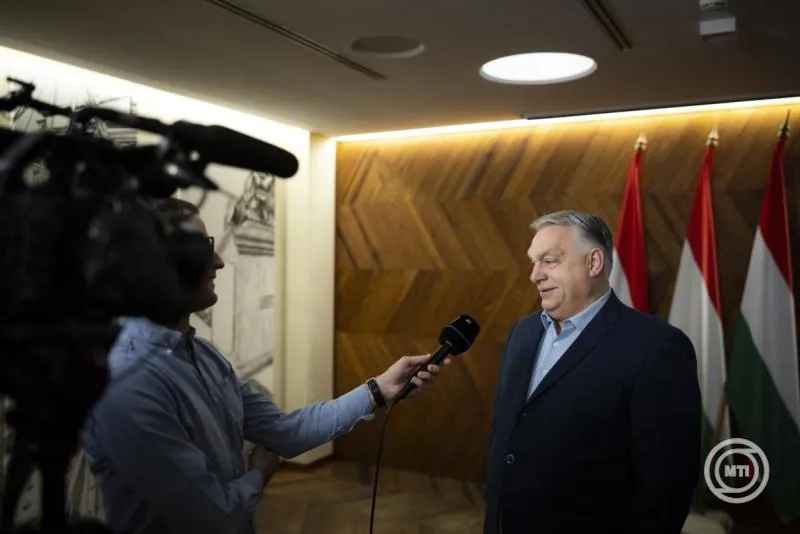
Prime Minister Viktor Orbán departed Budapest before sunrise on Friday for Moscow, where he is scheduled to meet Russian President Vladimir Putin for talks focused on Hungary’s long-term energy security. Speaking to Hungary’s state media at Liszt Ferenc International Airport, Orbán said his aim is to secure affordable energy supplies for both the coming winter and next year.
According to the state news agency MTI, Orbán emphasised that simply reaching Moscow has become a challenge due to the ongoing war in Ukraine. “The plan is not only to set off, but also to arrive,” he remarked, noting that the flight must take significant detours. “This is why we have to leave at 4 AM, to arrive in time for this morning’s meeting.”
Energy prices and Russian supplies
Orbán described the European energy market as highly volatile, saying that rising prices are putting pressure on both households and economies across Western Europe. He reiterated the government’s long-standing argument that Hungary is able to maintain the EU’s lowest household energy prices thanks to continued access to Russian oil and gas sold “below international market levels”.
He also defended his recent visit to Washington, stating that his goal had been to ensure that Hungary remains exempt from US sanctions targeting Russian energy companies. “We have achieved this, which is excellent. Now all we need is gas and oil—and these can be bought from the Russians,” he told reporters.
Szijjártó joins the Moscow delegation
Foreign Minister Péter Szijjártó also posted a video from Budapest Airport early Friday, confirming he was travelling with the prime minister. He proudly said that 8.5 million tonnes of crude oil and more than 7 billion cubic metres of natural gas have arrived in Hungary from Russia so far this year, calling the continuation of this cooperation a “fundamental national interest”, Telex reported.
Szijjártó highlighted the Paks nuclear expansion as the long-term guarantee for Hungary’s utility price caps. For the first time in years, he said, neither EU nor US sanctions are obstructing the project, and all domestic permits are in place. Preparations for the first concrete pouring—scheduled for 5 February—are underway.
Political timing raises eyebrows
Orbán’s trip comes only weeks after his high-profile visit to Donald Trump in the United States, and just days before an American delegation is expected in Moscow to discuss Washington’s evolving Russia-Ukraine peace plan. The prime minister’s visit was first reported by VSquare journalist Szabolcs Panyi, later confirmed by Telex, with the Kremlin acknowledging that an invitation was indeed in place.
The Hungarian leader last met Putin in Moscow in July 2024 during his self-declared “peace mission”, a visit that drew strong criticism from EU leaders. At the time, European Council President Charles Michel stressed that Hungary, holding the rotating EU presidency, had no mandate to negotiate with Russia on behalf of the bloc.
Orbán’s latest trip again coincides with crucial international discussions about potential pathways to ending the nearly three-year-old conflict. Reports on the still-unpublished US peace draft suggest it could involve Russia retaining the Ukrainian territories it currently occupies: an idea fiercely rejected by Kyiv. Ukrainian President Volodymyr Zelensky has repeatedly insisted that borders cannot be changed by force and that Russia must fully pay for the war it launched.
Hungary’s entrenched dependence on Russian energy
Despite the government’s messaging, experts note that Hungary is one of only two EU member states, alongside Slovakia, still importing Russian crude oil via the Druzhba (Friendship) pipeline. While Budapest and MOL claim to have secured US sanctions exemptions for this route, no official documentation has been published by Washington.
Analysts have also pointed out that Hungarian motorists no longer benefit from Russia’s cheaper crude, with fuel prices in Hungary consistently above the EU average since 2023. Any extra profits earned by MOL from cheaper Russian oil have largely been absorbed through special taxes.
Although alternatives exist for both oil and nuclear fuel (Hungary has contracts with France’s Framatome and the US-based Westinghouse), the Paks II nuclear expansion remains reliant on Russian financing and technology.



Why would Russia sell commodities at “below international market levels”? Well. At least its above cost – which is more than supermarkets get with the Politician price cap other-peoples-money give aways.
And paradoxically – Mr. Putin would not even entertain the notion of a personal meeting with Mr. Orbán, if it were not for Hungarys Membership of the European Union and NATO.
Russia gets to demonstrate cracks in European solidarity, maintain a level of diplomatic respectability and it is good propaganda for the Russian people. Whats there, not to like?
My opinoon is a crack of EU solidarity?
Solidarity means the EU stops trying to ruin Hungary.
And I imagined, I am a citizen of a sovereign nation. Thanks for telling me, I’m a slave to Germany and France. It’s greatly appreciated.
And you fail to understand, why the part of Europe, where the average IQ is still positive, because it’s not diluted by migrants from nations where the average is considered medically retarded by EU standard hates the EU leadership…. unbelievable.
So – what is the solution to The Evil EU? And our aging population – lagging fertility rate (we are not reproducing ourselves…) and spiking dependency rate? Very curious – look forward to your reply!
I’m glad to read that Orban cannot fly a direct route to Russia but must spend many hours on a long circuitous route. They already signed a 15 year energy agreement in 2021 so why does Orban have to go to Moscow to discuss “energy”. This is not something you need a delegation and face to face meetings for. This meeting is going to be about other things and it will be about what Putin expects Orban to do for him to disrupt the EU and NATO, what rewards Orban will get in return and how Putin can help Orban in his reelection campaign. For sure there will be discussion about Russian interference in the Hungarian election to help Orban.
First, it’s so pitiful to be glad, that someone is has a slightly longer flight. How bitter and desperate can one man get?
On the other hand, Orbán is trying to act as the envoy of POTUS.
Helping the USA is siding with Russia now? Sure. I mean you are the people, who don’t know what a woman is, so your cognitive decline shouldn’t surprise me.
I know, you guys want the Ukrainians to all die, Russia to take it over, so you can cry: “no we’ll be invaded, unless we introduce our dictatorship”, but that is a minority opinion.
Most people want the war to end, and people to stop dying, not what your owners brainwashed/ordered you to advocate for. That’s what Orbán and Trump represents: the majority. That’s why you hate them: it’s not the corrupt oligarchs you serve.
For all the talk of “Sovereignty!”, there appears to be an element that is very keen on throwing other countries under the bus. Sovereignty for which Ukrainians are fighting and dying, because (shocker) it is also of value to them?
Regarding Russias “imminent victory” – what started as a Special Military Operation is now stretching beyond the duration of WW1 …
And speaking of human cost – spare a thought (and perhaps a rant on a Russian channel) for the mothers, wives, brothers, sisters, and children of Russian servicemen.
https://en.zona.media/article/2025/11/21/casualties_eng-trl
Interesting reading, you will find. Only officially confirmed, mind you!
What amazes me is the complete contradictory hypocrisy of Hungarian proponents who will tell you how evil Ukraine and Ukrainians are – as Orban has claimed as a threat to Hungary. These same people will then come back and claim that they want to “save Ukrainian lives” while the supporters of Ukraine are deemed to be against Ukrainian interests as “pro war”. This is all Kremlin designed disinformation used to deny Ukraine the means to defend itself and push it towards defeat. Half the Hungarian population and plenty of bloggers here have been brainwashed by it. If you enacted the proposal to give up territory and cut Ukrainian military forces by half you are guaranteed another Russian invasion to finish the job after they reload. It would only be a pause in the conflict.