Subscribe to our social channels to get the latest news about Hungary!


The Croatian-Hungarian Zrínyi family’s members belonged to the wealthiest aristocrats of the Habsburg-ruled Royal Hungary. Without their soldiers and castles, the Ottoman Empire may have devoured Austria during the 16th-17th centuries. Yet, the Habsburgs regarded them with suspicion and have denied the minimal support from their military actions.
Knowing the pre-history of Austrian-Hungarian relations since the Battle of Pressburg in 907 AD up to the taking of Vienna by King Matthias in 1485, I can understand the Habsburgs’ viewpoint.
Beginning from the early 17th century, the Emperor’s treasury was empty and the lands and the huge wealth of the Hungarian magnates were more needed than ever.
The confiscation of lands has soon led to the uprising of Prince Bocskay in 1604 which was settled in 1606 by the Treaty of Vienna, in favour of the victorious Hungarians.
For the time being, the Court had to restrain itself from suing the Hungarian nobles for “treason”.
In the second part of the 17th century, the Habsburgs have utterly convinced themselves that the Hungarian nobles should be deprived of their wealth so they would not have money to rebel. They disregarded the harsh reality, that these very nobles and landlords were the last supporters of the impoverished warriors of the borderland castles who were defending 1,500 kilometers of a war zone against the Turks.
There are countless letters which bear witness that the Emperor left these soldiers unpaid in average between 2 and 9 years payment. Hungarian and Croatian warriors got two Forints a month while a foreigner mercenary received between 5-15 Forints plus food.
On top of that, regarding the lay of the land in Hungary, these mercenaries were mostly useless in the only effective hit-and-run warfare against the Turks. It did not help their reputation either, that in most cases the mercenaries kept surrendering the Hungarian castles when they faced a superior enemy, like in 1552 at Temesvár castle.
It is also not surprising that the Austrian field-generals and officers developed a very negative attitude against the local soldiers and captains, hindering them as much as they could. Taking away their booty or disregarding their deeds in the battle, were common things to them. Not mentioning the damage these mercenaries have done in the villages and towns.
No wonder, that time to time the alienated Hungarian nobles got embittered and felt themselves caught between two pagans – the Turks and the Austrians – and they decided the Turks the less evil one. Hungarians always had to balance delicately between these two powers, as it can be seen in cases of Prince Bocskay, Prince Bethlen and finally Prince Thököly.
Unlike Bocskay, the Zrínyies were Catholics and more loyal to the Emperor, than many magnates – despite all the negative and hostile attitude of the Court.
Let us take a glimpse at some members of this family.
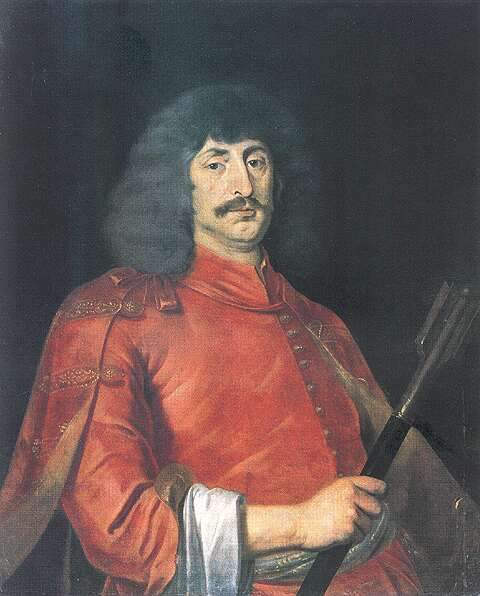
Count Miklós Zríny used to be a captain of the borderland who in cooperation with the other famous captains, was successfully blocking the Muslim expansion in the 16th century. Miklós Zrínyi was defending Vienna in 1529 against the Turks then he became “Bán” ( or Duke) of Croatia when he saved the Austrian army at Buda in 1542 with his 400 Croatian hussars. The same year he defeated the enemy at the lake Balaton at Somló, where the Turks had lost 3,000 men. His efforts were rewarded by King Ferdinand I, and Zrínyi never failed him. He heroically kept the lower part of the borderland and defeated another bigger Turkish army at Krupa castle in 1556. The same summer he had another major victory over the Ottomans at Babocsa. The king, seeing his success, stopped supporting him and Zrinyi resigned from his “Ban” function in 1557. That year he became the captain of Szigetvár castle. He defeated Bey Arszlan in 1562 who was destroying the Slavonian lands.


