Subscribe to our social channels to get the latest news about Hungary!


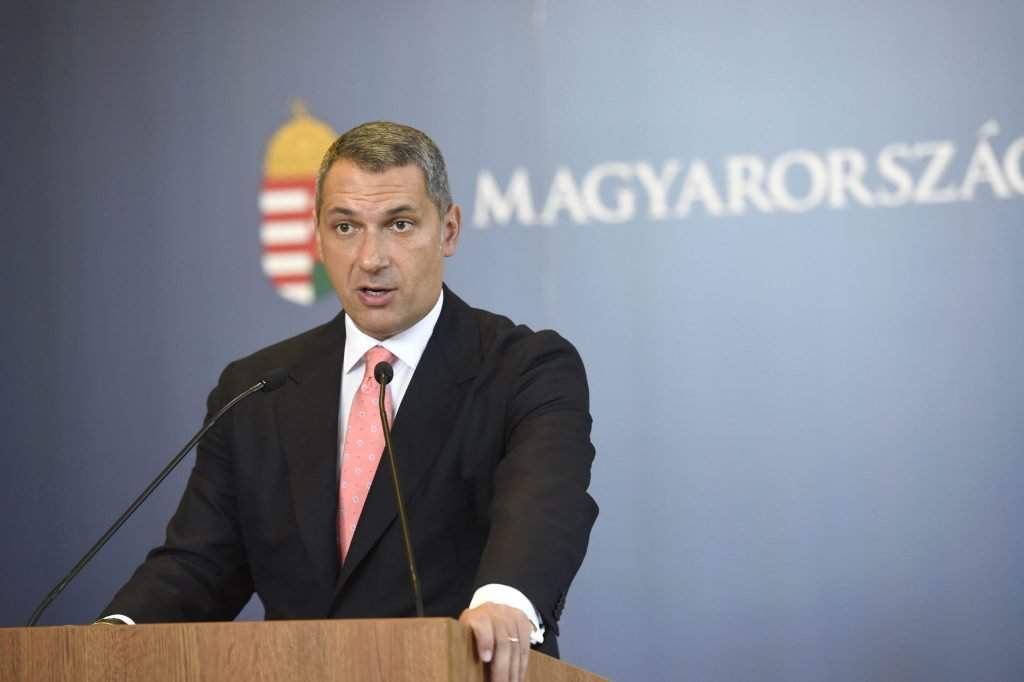
Budapest, August 18 (MTI) – If Hungarian voters “do not stop Brussels” then the European Union will fill up Hungary with people who are “not one of us”, János Lázár, head of the strategic cabinet, told a regular government news conference on Thursday, referring to the upcoming Oct. 2 referendum. The government plans to spend the 270 billion forints (EUR 869m) in revenues from farmland auctions on reducing the public debt, he said. The government also has started an internal investigation to uncover whether it was possible to influence decision-makers in connection with EU tender assessments, Lázár said. In the first half of the year Hungary’s economy performed well, he told, adding that growth had been accompanied by a continual reduction in the public debt. The government is drawing up a social programme for the 10-year period starting in 2018, he said.
Govt launches probe into graft allegation linked to EU tenders
Lázár told a news conference that ruling Fidesz lawmaker Roland Mengyi’s immunity would be certainly suspended. Mengyi himself initiated this procedure, he noted.
Prime Minister Viktor Orbán has ordered an investigation into the case because public monies are at the centre of alleged criminal activity, he said.
Lázár said he was “rather unhappy” about the issue, adding that this was the first case in six years that the suspension of immunity has been initiated by the public prosecutor’s office. At the same time, he said everybody deserved benefit of the doubt.
Hungary’s public prosecutor Péter Polt asked parliament to lift Mengyi’s immunity on suspicion of corruption involving public funds, a prosecution spokesman said on Thursday. Political weekly 168 Óra reported earlier this month that in 2015 Mengyi solicited bribes from social cooperatives in exchange for preferential treatment in their bids for European Union funding. The case involves five suspects.
In response to a question about allegations that the authorities were “instructed from above” not to “go for” Mengyi, Lázár said there is zero tolerance in corruption cases and the authorities had acted fully in accordance with the law. He said it was out of the question that anybody would have instructed them otherwise.
Lázár said recent years had witnessed a significant whitening in connection with the use of EU funds, which he said was “important” because “wherever they distribute much money, there are many interested parties.” In order to increase transparency, a new tender assessment system has been introduced according to which only state officials — as opposed to external companies — can be involved in the assessment process.
A total of 1,135 tender evaluators have been registered so far, he said. They “receive quite a lot of money” for their work and they agree to be monitored by the national security services, so they carry out their activity “under total control”, he said.
Referendum – Voters must prevent introduction of mandatory quotas
“The government on its own is weak in this fight,” Lázár said.
It is a big mistake to campaign for boycotting the referendum, he said. A real democrat has a duty to encourage voters to participate in it, he added.
Hungary has halted the wave of migration and has done Europe a big favour by upholding its rules, Lázár said.
There is a plan in the EU to import hundreds of thousands and millions of people into the bloc to satisfy economic and social interests, he said, adding that Hungary represents a minority position that migration must be stopped and there is no need for migrants. Instead, Hungarian families must be supported. This is the standpoint Hungary represents in the EU and the government has asked for its citizens to help in representing this position, Lázár said.
Hungary has become one of the most secure countries in respect of migration thanks to its laws and the fence on the external EU border, he said.
Regarding related funding, he said that the EU had given “essentially nothing” while Austria alone had offered help. “Germany and the EU have not,” he said.
Lázár said that the reason the government had decided to extend the state of emergency is because it is expected that more migrants will arrive in the autumn and migration pressure will increase. The agreement between the EU and Turkey is ineffective, he said, adding that the number of arrivals in Greece is growing and there are reports that people waiting at the border there are not “flinching from an attack”.
The reason why Hungary has raised the number of police at the border by 3,000 is that should Europe be under the current pressure for the next 5-10 years, it will be necessary to maintain the sealed border, he said. A smaller force would equal a “deficit in security”.
On the subject of Turkey’s request to Hungary to close a school in Budapest in connection with the recent attempted coup in Turkey and related accusations against Fethullah Gulen, Lázár said that Prime Minister Viktor Orbán had instructed the foreign and interior ministries to examine the request. The government’s standpoint is that it is in Hungary’s interest that Turkey must remain stable in order to maintain the region’s security and solve the migration crisis, he said.