Subscribe to our social channels to get the latest news about Hungary!


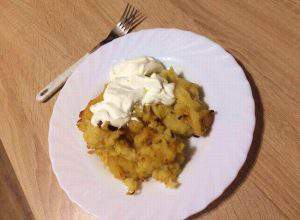
Dödölle, mostly known from a popular children’s song, is a traditional Hungarian meat-free meal, which is very filling and cheap. Hence, it was almost an everyday dish in older times: people only had to go out to the garden to get the ingredients. It is still popular all over Hungary, however, it has several variations.
It is believed that even picky kids love it: they first take a liking for the song and then the meal. It is quick and easy to make, it tastes delicious and it is very filling. The icing on the cake is that it is also cheap.
Éliás, Tóbiás, egy tál dödölle, Elias, Tobias, one pot of dödölle,
Ettél belőle. You had some of it.
Kertbe mentek a tyúkok, The hens went out to the garden,
Mind megették a magot. And ate all the seeds.
It’s no surprise that its consumption was almost an everyday activity in older times: all ingredients grew in the garden.
The key ingredient is the potato, therefore the first step to this lovely dish was the discovery of the New World and the spread of the vegetable. According to netfolk.blog.hu, before that, our ancestors mostly ate mushes made from wheat, rye, corn and millet. They flavoured the mushes with lard, sour cream, cottage cheese and crackling, or sugar and jam when consumed as dessert.
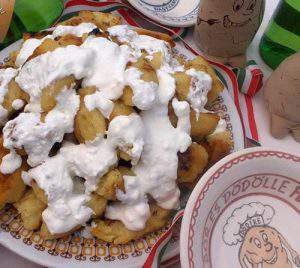
The word “dödölle” was first written down in 1792. The potato mush became thicker than the normal mushes, but the list of “toppings” didn’t change much. Queen Maria Theresa indirectly facilitated the birth of the meal since she was the one who ordained the cultivation and consumption of potatoes in Hungary to combat famine.
What’s also quite interesting is that its name differs by regions. It is called dödölle in most places, but it is also referred to as krumpligánica in Zala and Vas County, gánica in Baranya and Somogy County, gáncá in Palóc Land, cinke in Szabolcs-Szatmár-Bereg County. Moreover, if someone says pipice or chamulya, they also mean something very similar.