Subscribe to our social channels to get the latest news about Hungary!


According to index.hu, the National Dance Theatre had been functioning in the Carmelite Monastery in the Buda Castle until recently, when it was decided that the monastery would be turned into a prime ministerial residency. So the theatre had to leave in 2014. It was decided that their new home would be at the Millenáris Theatre, which is going to be reconstructed, therefore the company has to perform at alternative locations for one and a half years. The process of moving is not going quite smoothly, but it seems that the final result will be perfect.
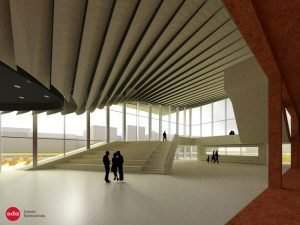
Gábor Zoboki presented the plans – made by his office – about the reconstruction last week. He is quite experienced in the subject since he designed one of the coolest public buildings in Budapest, the Müpa (Palace of Arts), and he is also responsible for the works in the Buda Castle, so he probably knows the necessities of the dance theatre.
The location in question, the Millenáris Theatre was originally the transformation house of Ganz Művek, but when Millenáris was developed in 2001 the building was turned into a theatre. An interesting outdoor stage was added with a cool looking row of bells to make it the home of the most diverse performances.
The reconstruction will start in the beginning of next year and end in February 2018. It will cost a total of 3.3 billion forints, without the 608 million worth lighting and audio technology. So it is not a simple recoating.
According to the architect, the palette of Budapest’s cultural buildings is fascinating and it’s important that the National Dance Theatre gets a similarly high-standard home. This takes a professional location created for this exact purpose, which is spacious, and actors can enter from all directions.
The base is a symbolic space, since we’re talking about the generator house in the factory where Bláthy, Déri and Zipernovszky invented the transformer. Zoboki believes that dancers have to take on the heritage of these geniuses. For that matter, the building itself is an industrial memorial, so the basic structure of the basilica-like house will remain.
The most important change is the abolition of the outdoor stage, where a foreground will be formed as it wasn’t made during the original construction at the millennium. The architect said that a good theatre building has a head, thorax and swag-belly (foreground, stage and serving area), however this practically doesn’t have a head now or, at least, it is undeserved for a theatre.