Subscribe to our social channels to get the latest news about Hungary!


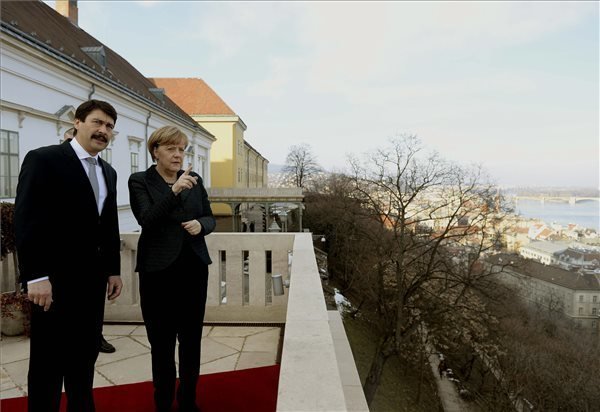
Budapest, February 2 (MTI) – German Chancellor Angela Merkel called Viktor Orban a “colleague” with whom she “closely cooperated” and stressed that the Hungarian premier agreed with her that “the EU is a great asset”, saying: “Europe is always strong if its countries can take united action.” But the two leaders agreed to disagree about the nature of democracy.
In response to a question about Orban, she said, “In the interest of European unity, he is prepared to compromise.”
“Everything can be discussed with him,” she told students in a question-answer session as part of her one-day visit to Hungary. The chancellor added, however, that there are some points of disagreement, such as their views on liberal and illiberal democracy. Asked about “illiberal democracy” at her joint press conference with Orban earlier, Merkel said she could not interpret the word illiberal in the context of democracy. The roots of democracy had always been connected with liberalism, she insisted.
Orban, for his part, called the German chancellor “the most important and most vocal advocate of European unity”. But in reply to a question by a German journalist concerning democracy, Hungary’s prime minister said that not every democracy is necessarily a liberal one.
Pluralism, peace and freedom constitute the foundations of Europe, Merkel said. These are values that European nations should take a stand for in the Ukraine conflict, she said.
 It is on the basis of these values that European countries should jointly fight against the discrimination of minorities, the German chancellor said. These are the values that are reflected by civil organisations and the independent media, too, Merkel said in a lecture held in the Andrassy Gyula German-language University.
Concerning the crisis in Ukraine, Merkel said that Russia, with its actions, had countered those ideals and tried to show that might is right instead of recognising the might of the law. She criticised Russia for having violated Ukraine’s free and peaceful political order and its right to freely decide its fate. However, she stressed the need to develop good relations with Russia and guarantee security in cooperation with, rather than against, that country.
Merkel said the Minsk Agreement reached last September should be implemented. This is what Europe’s “approach” to sanctions against Russia would depend on, she said. The chancellor admitted that the sanctions had caused a loss to the European Union but “freedom and law should be respected”.
Orban said that, looking at Europe’s strategic and historical horizon, he could not imagine an EU which did not incorporate Russian energy resources and raw materials.
Both leaders said that neither Germany nor Hungary would supply Ukraine with weapons. Merkel said Germany was grateful to Hungary for helping Ukraine by renewing gas supplies.