Subscribe to our social channels to get the latest news about Hungary!


János Neumann was a Hungarian mathematician of Jewish origin. Born on the 28th of December, in 1903, he was the first child of a noble family. The father, Miksa was granted the hereditary title “margittai”, which János proudly used, before changing his name to Johann von Neumann, then John von Neumann, as he had become famous worldwide.
His family regarded János as a wonder child before the age of ten. The little John could joke in classical Greek and could quickly memorise a page from a telephone book and recite its numbers and addresses. He attended the “Fasori” Lutheran Secondary School, then, in 1921, he enrolled in the Budapest Science University’s Faculty of Mathematics. He often stayed in Berlin during his university years.
Here he had the opportunity to learn actuary mechanics from Einstein (he was not the only Hungarian student of the physicist genius) and maths for Erhardt Schmidt.
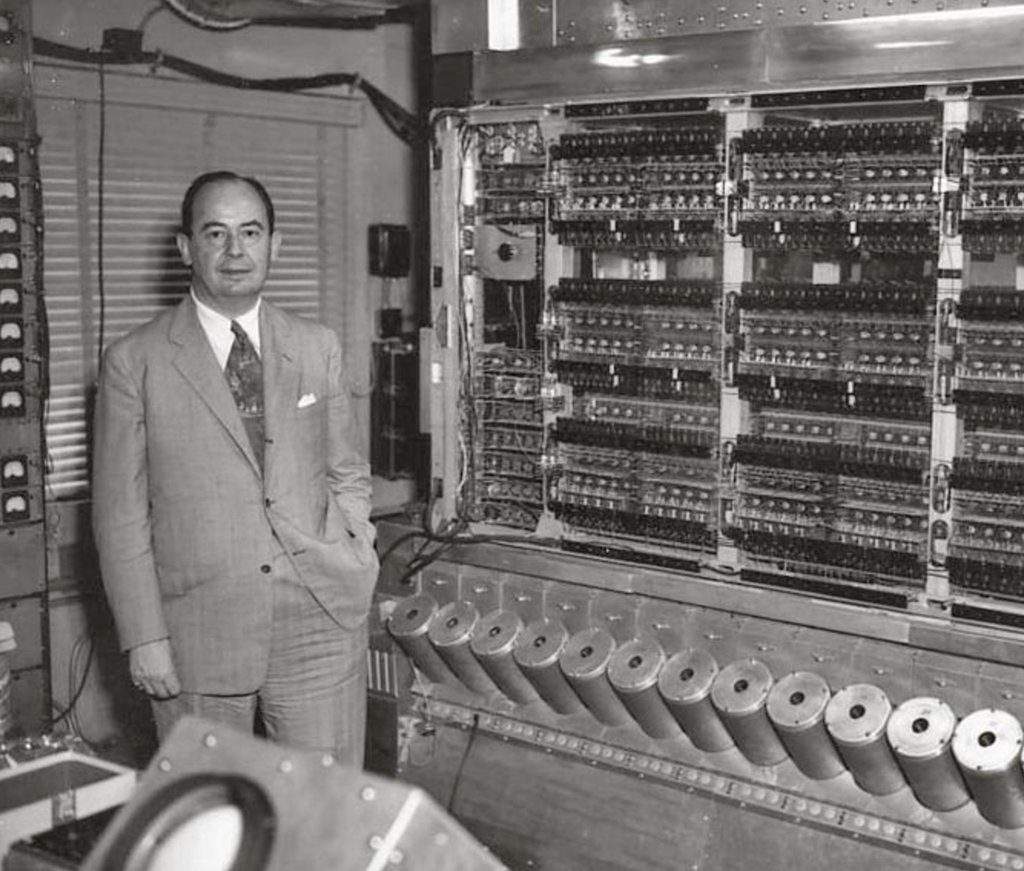
Photo: Wikicommons by LANL
He also made close connections with Wigner, Leo Szilárd and Dénes Gábor. In 1923, he started studying chemistry in Zurich, on his father’s request. He received his chemical engineering degree in 1925, and a year later, he finished the doctoral studies of mathematics in Budapest.
In 1928 von Neumann published “Theory of Parlor Games”, a critical paper in the field of game theory. The game of poker was its nominal inspiration. His game theory publication focuses on the element of bluffing. In games like poker, the optimal strategy incorporates a chance element. Poker players must occasionally bluff—and unpredictably— to avoid exploitation by a savvier player.
He was invited to Princeton in 1930 as a visiting professor. He soon became a professor of the university, then of the Institute for Advanced Studies, though he was known as a mediocre teacher: he would write too quickly and then erase the blackboard before students could have finished copying. When he was no longer teaching, he became a Princeton legend.
It was spread that he would play practical jokes at Einstein, could recite books he had read years ago word-for-word, and he could edit assembly-language computer code in his head.
During WWII, he took part in military technical research, just like many other scientists.
He began working on the Manhattan Project at the invitation of Oppenheimer.
At Los Alamos, New Mexico, von Neumann worked on Seth Neddermeyer’s implosion design for an atomic bomb. After the war, he also promoted the idea of the hydrogen bomb. From 1954 until 1956, von Neumann served as a member of the Atomic Energy Commission and was an architect of the policy of nuclear deterrence developed by President Dwight D. Eisenhower’s administration.