Hungary adopts OECD declaration on consumer protection in digital, green transitions
Change language:
Hungary has adopted a declaration committing to further protecting and empowering consumers in the digital and green transitions at a meeting of the OECD’s Committee on Consumer Policy, the National Economy Ministry said on Thursday.
Bence Gerlaki, a deputy state secretary at the ministry, highlighted the need for consumer protection authorities to take steps against online marketplaces outside of the European Union that fail to comply with basic rules on product safety.
Hungary also joined an OECD awareness campaign on the safe and responsible use of lithium-ion batteries, the ministry said.
Hungary ‘making strides’ in green transition – minister
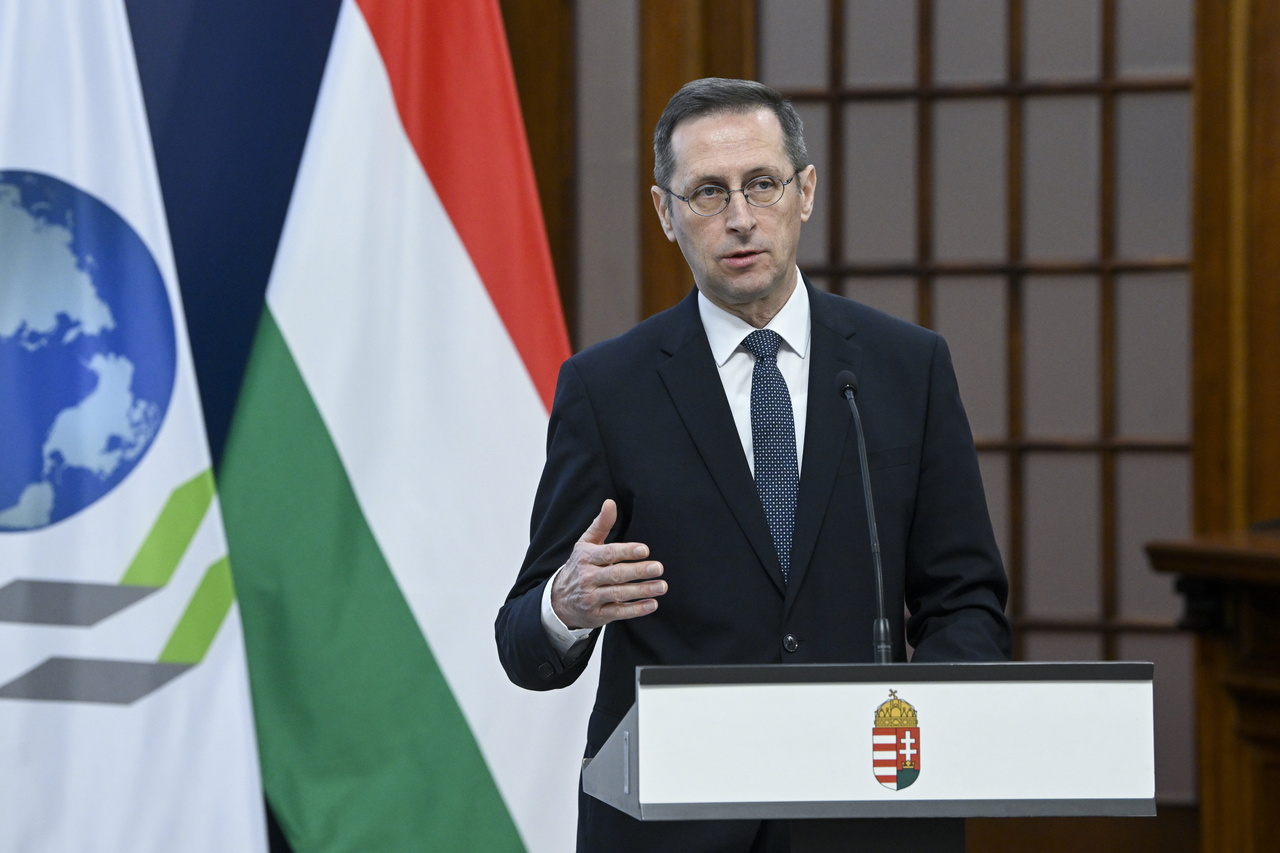
Minister of Finance Mihály Varga speaks at the presentation of the Organisation for Economic Co-operation and Development (OECD) country report on Hungary in March 2024. Photo: MTI/Koszticsák Szilárd
Energy Minister Csaba Lantos said Hungary was “making strides” in the green transition, addressing the Portfolio Energy Investment Forum on Thursday.
Lantos said Hungary aimed to boost the share of renewables in gross final energy consumption to 30pc by 2030. He added that 85pc of state-owned energy group MVM’s electricity output was carbon-neutral, but the rate of zero-carbon electricity in consumption sometimes reached 100pc.
Last year, Hungary’s solar power capacity was the third-biggest in the world and now stands at 7,200 MW, he said. That capacity is set to reach 12,000 MW by 2030, but will require infrastructure upgrades, he added.
Around 280,000 homes in Hungary have solar panels.
Lantos said energy investment subsidy programmes with a combined value of HUF 1,200bn were underway. He added that without nuclear energy there could be no sustainable climate policy.
He said Hungary was among the top five countries in Europe in terms of tapping geothermal energy, and he saw potential for making biogas. He added that energy storage was a “big task” and noted that a feasibility study for a pumped storage facility would be completed by year-end.
Acknowledging Hungary’s dependence on energy imports, Lantos said gas was part of the green transition as Hungary couldn’t give it up “from one day to the other”. He added that Hungary’s gas stores were at 93pc of capacity.
He said that Hungary was no longer dependent on transit deliveries of gas via Ukraine, which were likely to cease at year-end, while MVM had recently acquired a 5pc stake in one of the world’s biggest offshore gas fields, in Azerbaijan.
Hungarian-Serb integrated water management project launched on Tisza river
A Hungarian-Serbian cross-border cooperation project has been launched with EU funding to tackle challenges posed to water management by weather extremes and related floods and droughts on the Tisza River in the border region, the communications department of the Szeged University, a project partner, said on Thursday.
Weather extremes resulting from climate change and related events have become a significant threat to communities, infrastructure and ecosystems in the Tisza river’s basin and its catchment area, the department said in a statement.
These challenges have prompted the launch of a cooperation project involving water and disaster management experts and researchers in the Hungarian-Serbian border region with the aim to mitigate hydrological risks and increase the region’s resilience to weather extremes, it said.
Dubbed ADAPTisa, the project’s participants include Szeged University’s research team and Hungary’s Lower-Tisza District Water Directorate, and Serbia’s European Affairs Fund of Autonomous Province of Vojvodina and Public Water Management Company “Vode Vojvodine”.
The EU is providing EUR 1.2 million to the total project cost of EUR 1.4 million, according to the statement.




Nothing that comes from EU should be accepted by Hungary. It opens another channel for a curt case.