Hungarian opposition parties commemorate 1956 uprising
Budapest, 23 October 2022.
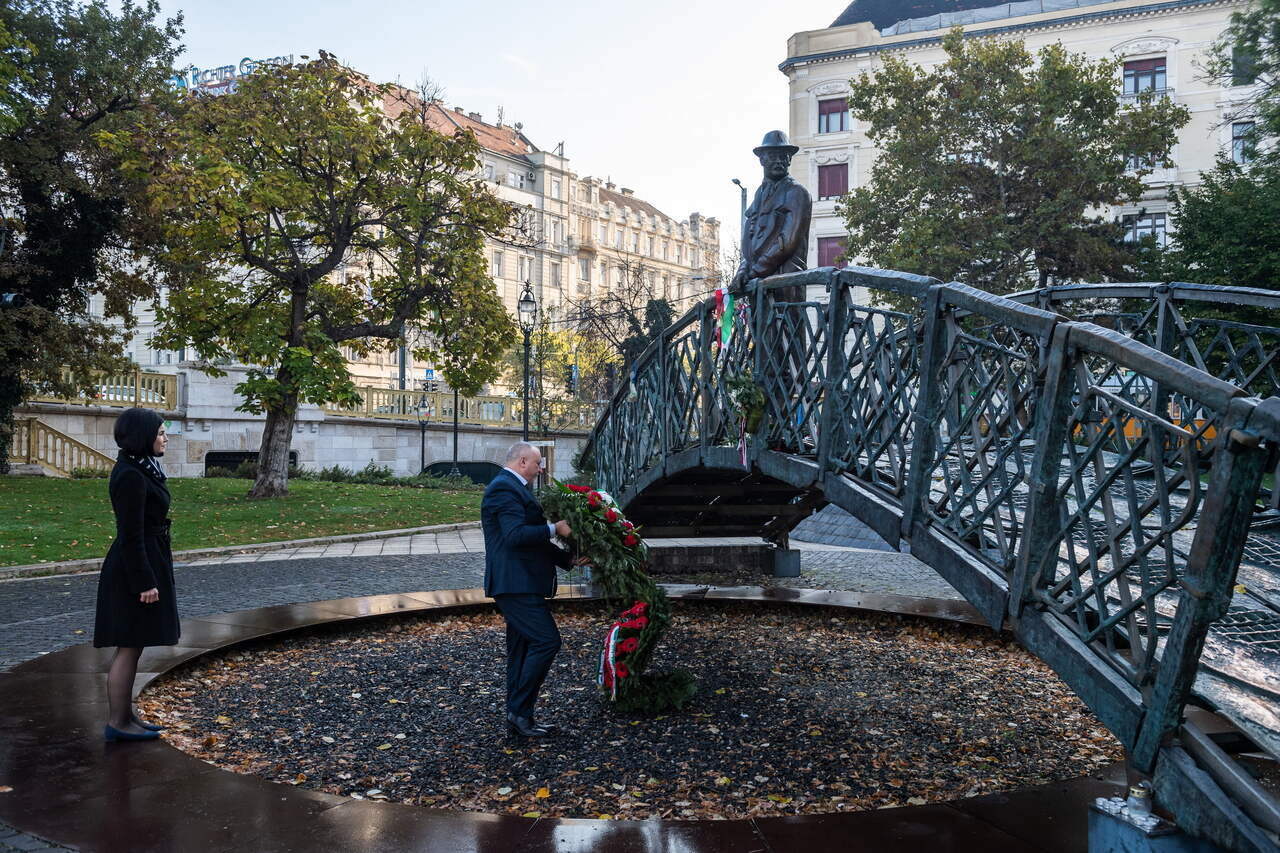
Imre Komjáthi, co-chairman of the MSZP, gives a speech, next to him is co-chairwoman Ágnes Kunhalmi at the party's commemoration ceremony for the 66th anniversary of the 1956 Revolution and Freedom Fight in Budapest, at the statue of Imre Nagy on 23 October 2022.
MTI/Márton Mónus
Change language:
Opposition leaders on Sunday addressed gatherings in Budapest on the occasion of the 66th anniversary of the outbreak of the 1956 revolution and freedom fight.
“Everyone belongs to the nation,” Ágnes Kunhalmi, co-leader of the opposition Socialist Party, said at the statue of Imre Nagy. “The streetfighters of the 1956 uprising, martyred prime minister Imre Nagy, as well as those who are now fighting for a better education, have been key to the nation’s future,” she said.
Kunhalmi insisted that in recent years Fidesz had tried to deny the role of Imre Nagy in the events, focusing solely on the young streetfighter heroes of the uprising. But the martyred prime minister “played just as an important role in 1956 as those who fought in the streets against an authoritarian regime”, and was a victim of it, she added.
Kunhalmi said the young people demonstrating today for a better education, a better country, and a shared national cause “are also victims of this authoritarian regime”, which Fidesz, she insisted, had built over the past 12 years.
Budapest, 23 October 2022. Ágnes Kunhalmi and Imre Komjáthi, co-chairs of the MSZP, wreath the party’s statue of Imre Nagy at the commemoration of the 66th anniversary of the 1956 Revolution and War of Independence in Budapest, 23 October 2022. MTI/Márton Mónus
Socialist co-leader Imre Komjáthi said that in October 1956 the Hungarian people had rejected dictatorship and embraced democracy. “Our task today is to lead Hungary back to the path of democracy,” he said.
Bence Tordai, co-leader of the opposition Párbeszéd party, said the hopes and objectives of 1956 had been fulfilled when Hungary became a free and sovereign country thirty years later.
Tordai was speaking at his party’s commemoration of the 1956 uprising at the monument of Péter Mansfeld, the youngest victim of the reprisals, in Budapest’s 1st district. As the heroes of 1956 were the young streetfighters, Tordai said, “our hope is again invested in the young people who are out in the streets,” where they “must face an authoritarian regime … and protect their lives, their future, and the life and fate of their teachers.”
Recalling Péter Mansfeld and the other young heroes of 1956, Tordai said nobody should give up hope, and if they had lost hope, they should think of those who never gave up, since later on history confirmed the validity of their ideas and aspirations.
Péter Ungár, co-leader of the LMP party talked about the shared fate of the peoples of the region at his party’s commemoration in Budapest. Ungár said the message of 1956 was that those living in the region “must stand up for each other if they are to stand up for themselves”.
“When speaking of 1956, it’s often said that all we received from the West were nice words but no help, and we were left on our own,” he said. Yet other central European peoples stood up for Hungary, he added, even at a great sacrifice.
What was special about the events of 1956 is that they were at the same time a revolution against communist dictatorship and a freedom fight to regain Hungary’s sovereignty from the occupying Soviet army, Ungár said.
In connection with the war in Ukraine, Ungár said Hungary could not accept any solution to the conflict that would lead to Ukraine becoming a puppet state, because Hungary would then find itself dangerously close to the Russian empire.
Ferenc Gelencsér, leader of the opposition Momentum Movement, said the first step of the freedom fight was to say that “we do not want to live a lie any longer”. Addressing his party’s commemoration, Gelencsér said people from various backgrounds had come together on 23 October to reject the lies of communism, and this had shaken the dictatorship to the core.
Gelencsér said the dictatorship of the era accused the revolutionaries of being foreign agents, even though they were only fighting for values that “are sadly still missing today: free education, free university, free press, free elections.”
Ferenc Gyurcsány, head of the opposition Democratic Coalition (DK), accused the government of being unworthy of the legacy of 1956.
At his party’s commemoration, he said a government that failed to acknowledge the right of the Ukrainian people to self-determination and freedom was unworthy of the legacy of 1956. “Today the Hungarian government fights for sovereignty where there is in fact sovereignty, and falsely talks about freedom where there is autocracy,” Gyurcsány said.