How well do you know the English language? – Words that come from Hungarian
Change language:
How well do you really know the English language? English has become an actual global language over the past centuries, but during the course of its existence, just like with most languages, history has left its mark on it. English has been influenced and impacted by many other languages and cultures, from French to German, from Greek and Latin to Spanish, but to some extent, also by Hungarian. In this article, we try to gather all words in the English language that have Hungarian origins.
If you are a long-time follower of this site, you will probably recognise some, if not most, of these words. Let us start with English words that come from proper Hungarian names.
Proper names
Rubik
This is probably the second outlier, but it is so well-known worldwide that it had to be included. It comes from none other than Ernő Rubik, the inventor of the world-famous Rubik-kocka, or Rubik’s cube.
Source: Pixabay / congerdesign
He invented it around 1975, and it was called “bűvös kocka” (magic cube) back then. Shortly after, it was nicknamed Rubik-kocka, and the name stuck. Since then, it has become a kind of brand, and there are many varieties of brain-teasing puzzles under Rubik’s name.
Tokay
“A name of a town in Upper Hungary (‘Tokaj’). Also, Tokay (‘Tokaji’) wine, rich sweet wine of an aromatic flavour, made near Tokay in Hungary. Tokay grape is the variety of grape from which Tokay wine is made.” – Oxford English Dictionary
Photo: Facebook.com/tokajiaszushop/
“The Tokaj aszu (or ‘Tokaji aszú’ in Hungarian) is a special wine produced in the Tokaj wine region; it is the nectar of individually hand-picked “aszu” berries botrytised on the vine stock” – Collection of Hungarikums. You can read more about this unique wine HERE.
Biro
The ballpoint pen is widely referred to as a ‘biro’ in many countries, including the UK, Ireland, Australia, and Italy. It is a registered trademark that comes from the name of its inventor László József Bíró, who was a Hungarian-Argentinian inventor.
He patented the first commercially successful modern ballpoint pen. In 1945, Marcel Bich bought the patent from Bíró for the pen, which soon became his company’s main product. BIC has since sold more than 100 billion ballpoint pens worldwide.
Foods
Dobos torte
“A torte made of multiple thin layers of sponge cake often containing ground hazelnuts, put together with a mocha-chocolate filling, and topped with caramel glaze,” – Merriam Webster Dictionary
“The layered pastry is named after its inventor, Hungarian chef József C. Dobos, a delicatessen owner in Budapest. Dobos cake was first introduced at the National General Exhibition of Budapest in 1885; King Franz Joseph I and Queen Elisabeth (Sisi) were among the first to taste it. The cake soon became popular throughout Europe” – Collection of Hungarikums.
Source: facebook.com/GerbeaudCafe/
We have already written several articles about this delicacy, and if you would like to try it at home, we also have the original recipe you can try.
Paprika
It is one of the staples or perhaps even the soul of Hungarian cuisine, and according to the Oxford English Dictionary, it is a powdered spice that looks deep-orange or red, made by grinding the dried fruits of peppers.
In many languages, ‘paprika’ also refers to the plant itself, but not in English. ‘Paprika’ has been part of Hungarian cuisine since the plant’s arrival to the country around the 16th century. It is so characteristically Hungarian that paprika made from the peppers of Szeged and Kalocsa have become Hungarikums.
Goulash
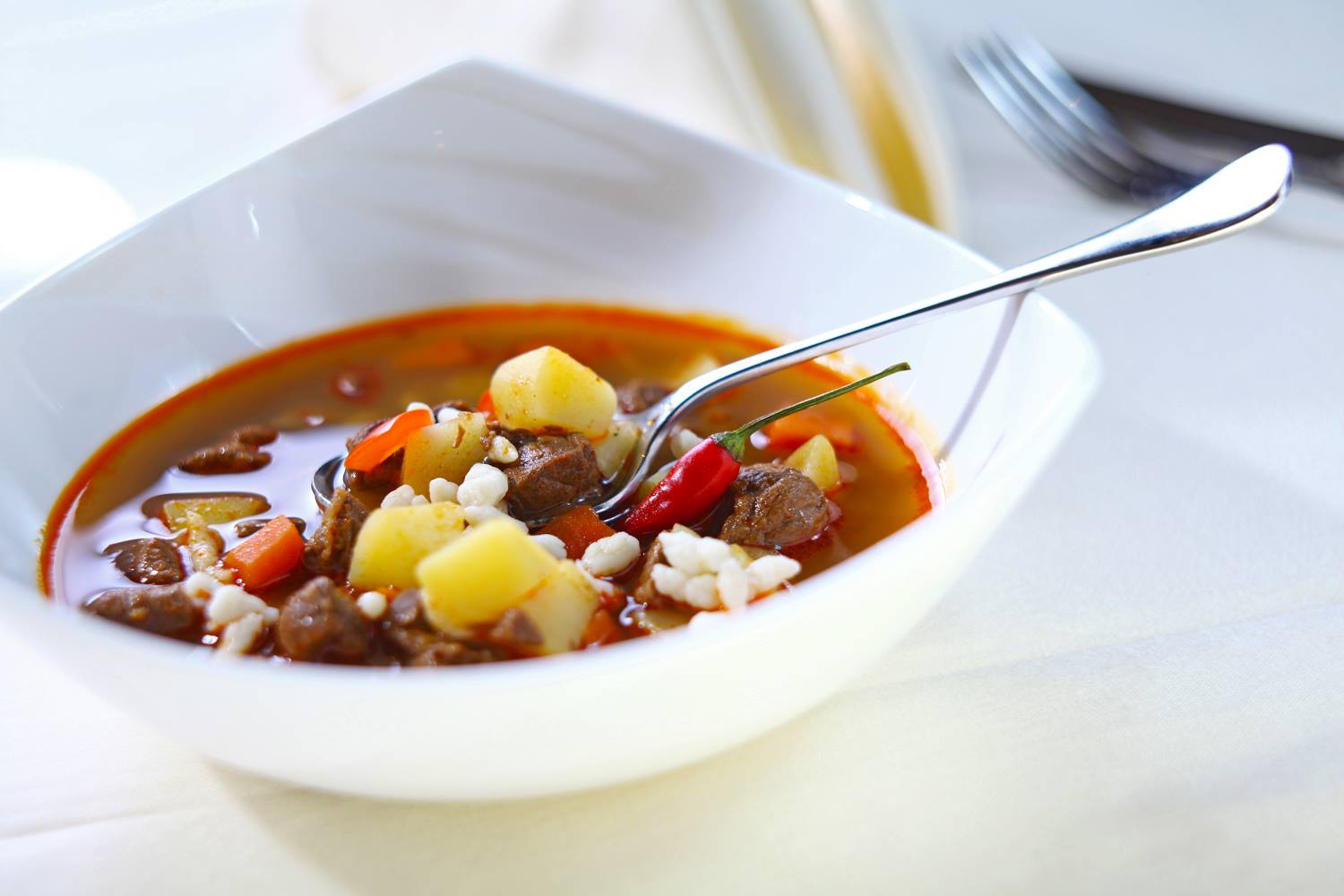
This might be one of the most well-known and most commonly used words in English that originate from Hungary. It is not uncommon for foreigners to identify Hungarians with this dish.
Photo: facebook.com/magyargulyasetterem
“It originates from Hungarian ‘gulyáshús’, from ‘gulyás’ (herdsman of ox) + ‘hús’ (meat). A beef or lamb soup originally made by herdsmen while on the fields” – Online Etymology Dictionary.
The real question, however, is whether it is a soup or a stew. Find out HERE.
‘Halászlé’ or fisherman’s soup
It is another dish that uses quite a lot of paprika, the halászlé or fisherman’s soup, sometimes fish soup might be almost as well-known as goulash is. Every cook does it differently, but there is a heated debate between the two main types. One is the ‘Tisza’ (river in eastern Hungary) fish soup, and the other is the ‘Baja’ (a city in southern Hungary, next to the Danube). Never mention one to the other area.
Palacsinta
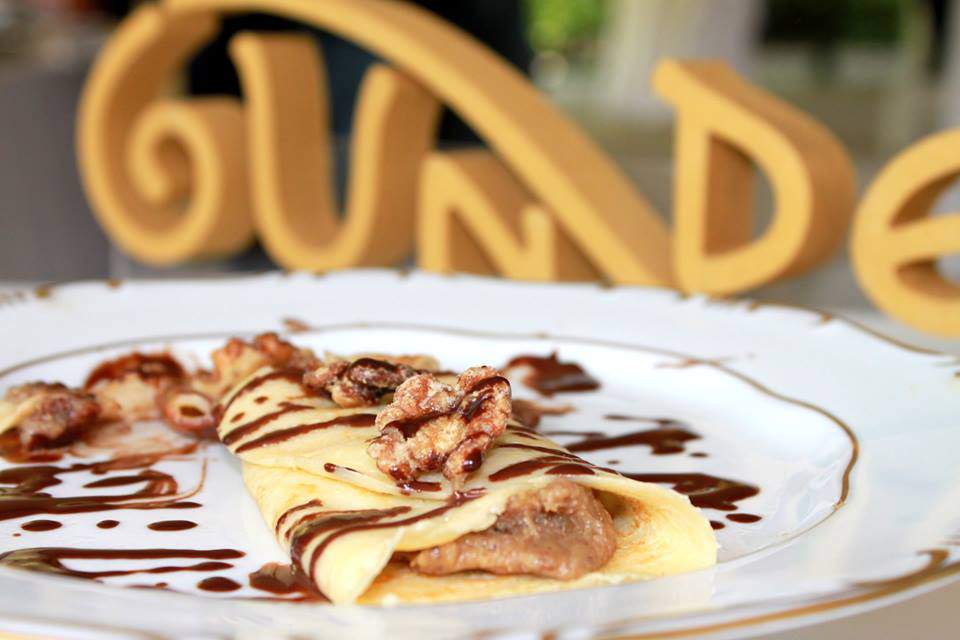
“In Hungarian cuisine: a thin pancake eaten as a dessert, often filled with jam, cheese, nuts, or chocolate” – Oxford English Dictionary.
Photo: facebook.com/GundelRestaurant
You can call it a pancake, but it might actually be closer to French crêpes. Regarding the fillings, the sky is the limit. Most often, you could find ‘túró’ as a filling, sweetened and sometimes with raisins. I personally like a little vanilla flavouring but hate raisins. You could use any kind of jam or marmalade, cocoa (sweetened), Nutella, pudding, but another one of my favourites is cinnamon with powdered sugar. There is also the famous Gundel ‘palacsinta’.
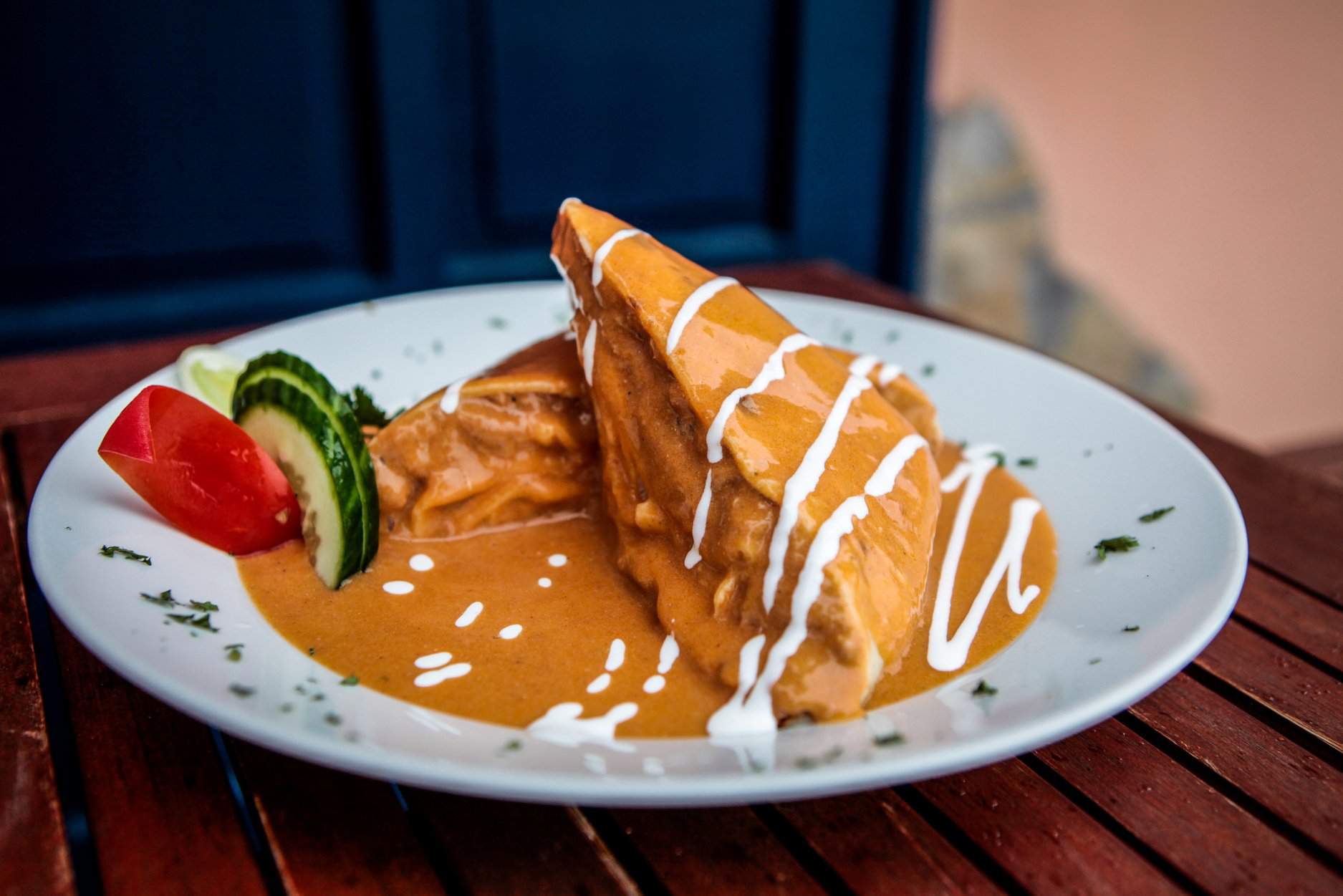
It is usually a dessert item, but there is also a savoury type that restaurants list with appetisers. It is called the ‘Hortobágyi húsos palacsinta’, meaning Hortobágy (a region in eastern Hungary) meat pancake. It contains minced meat, and it is drizzled with sour cream and – of course – paprika gravy.
“It means light-cavalryman. The original Hussars were bodies of light horsemen organised in Hungary in the late 15th century, famed for courage and elaborate, semi-oriental dresses. They were widely imitated all over Europe” – Online Etymology Dictionary.
According to Webster’s Dictionary, the Hungarian ‘huszár’ originates from the medieval Serbian husar, meaning brigand (because early hussars’ shock troop tactics resembled that of brigands). Another theory is that the term is an original Hungarian one, having nothing in common with the Serbian ‘gusar’.
This type of light cavalry was especially characteristic of the Hungarian armies, equipped with bows, arrows, spears, and sabres, later adopting the use of firearms.
“Also ‘chako’ is a cylindrical soldier’s hat with plume. It comes from the Hungarian ‘csákó’, short for ‘csákós süveg’ (peaked cap)” – Online Etymology Dictionary.
Photo: Alpár Kató – Daily News Hungary
An essential part of the Hussar dress, but also a paper toy that children can easily make.
Sabre
“It is a type of single-edged sword, […] probably ultimately from Hungarian ‘szablya’ (saber), literally means a tool to cut with, from the verb ‘szabni’ (to cut or to tear).” – Online Etymology Dictionary
A sabre or saber is a type of backsword with a curved blade associated with the light cavalry of the early modern and Napoleonic periods. Originally associated with Central-Eastern European cavalry, such as the hussars, the sabre became widespread in Western Europe a bit later. The sabre probably arrived in Europe with the Magyars and Turks.
Verbunkos
“A borrowing from Hungarian, the ‘verbunkos’ was originally danced by uniformed Hussars to the music of gipsy bands in Hungary in order to attract recruits to the army. The Hungarian word comes from the German ‘Werbung’, meaning recruitment.” – Oxford English Dictionary
Hungarian Dog Breeds
Puli
“More fully Hungarian Puli is a breed of large black, grey, or white sheepdog characterised by a long, thick coat with a corded appearance.” – Oxford English Dictionary
Komondor
“Large, powerful, shaggy-coated white dogs of Hungarian origin that are used to guard sheep” – Merriam-Webster
Kuvasz
“A large, white, long-coated Hungarian breed of dog used as a guard dog” – Oxford English Dictionary
Vizsla Photo: Pixabay / Anna-f
Vizsla
They are short-coated, golden-brown hunting dogs, specifically “pointers, with large pendant ears” – Oxford English Dictionary. They are robust but rather lightly built; they are lean dogs that have defined muscles.
Pumi
“It is a medium-sized alert, intelligent, energetic, and agile Hungarian herding breed” – American Kennel Club
Pusta or Puszta is a traditional Hungarian landscape meaning “a large plain, a steppe; a flat, treeless region.” – Oxford English Dictionary
Fogas
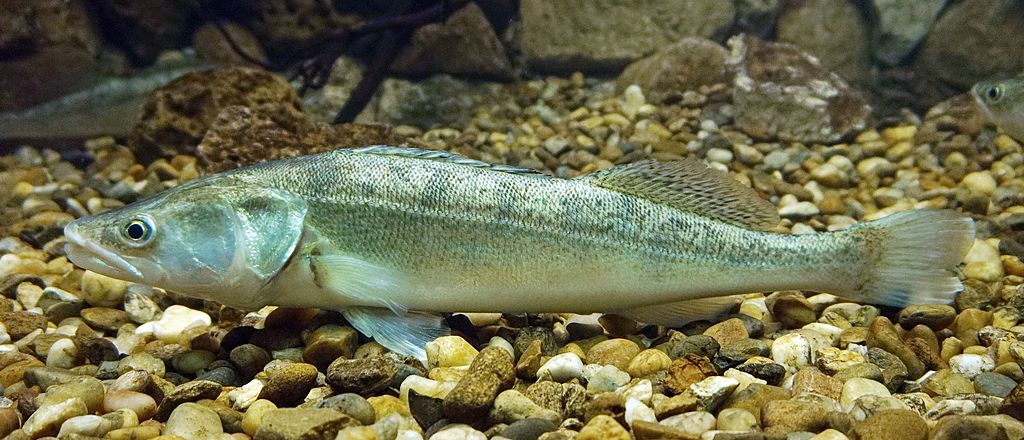
“An Eastern European fish (Lucioperca sandra) resembling a perch, especially one from Lake Balaton in Hungary that is highly esteemed as food,” – Merriam Webster Dictionary
‘Fogas’ or also referred to as ‘süllő’ depending on its size; the latter is smaller than 1.5 kg Source: Wikimedia Commons / Tiia Monto
“The principal monetary unit of Hungary; a coin of this denomination.” – Oxford English Dictionary.
Pengö
In Hungarian, it is written ‘pengő’. It was “the basic monetary unit of Hungary from 1925 to 1946.” – Merriam Webster Dictionary
Czárdás
‘Csárdás’, often seen as ‘czárdás’ or ‘csardas’, is a traditional Hungarian folk dance. The name is derived from ‘csárda’, an old Hungarian term for roadside tavern and restaurant. It originated in Hungary and was popularised by bands in Hungary as well as the neighbouring lands of Slovakia, Slovenia, Transylvania, etc.
What about word ” havoc” ,as it’s similar meaning in the English and Hungarian
Very interesting.
However, forint obviously derives from fiorino, the currency in use in medieval Florence.
Palacsinta exists in different versions in several neighbour countries, I am not sure it is a Hungarian word.
They did not enter the English Language. They are the names of people and things. Probably the only word to enter English from Hungarian is “coach”.
This article seems a bit far fetched. I do think some English words probably did come from the Hungarian language, this article seems to be only concentrating on words that describe traditional Hungarian things.
I think any nation could find multiple words in the English vocabulary about their traditional things.
Many of these words are either proper nouns, the names of people or things.
Others are not genuinely used in English to any great extent.
Many words that are genuinely used are words connected with training horses, and also military words. Hossa for example. Also many words connected to military uniforms and their parts are lifted from Hungarian.
As Ian said, the “coach” is the only English word with Hungarian origin (kocsi). The Hungarian word kocsi, comes from a village, namely Kocs, which was famous for producing horse carts in the 16th century
Bureau is a French word. Fish soup is made around the world and is not especially Hungarian, Pancakes were made by the Ancient Greeks and Romans….the list goes on. This article is total nonsense.
The English noun ‘sabre’ comes from the German word ‘sabel’ and influenced by the French spelling ‘sable’ not from Hungarian.
The article’s title misrepresents the information contained in it. Rubic is the only word that is heard in the English language by average citizens that I can think of from this article.
North Americans eat thick, heavy somewhat stiff & occasionally fluffy pancakes with maple syrup & often a pat of butter for flavouring. Very filling! We used to have “pancake Tuesdays” to stretch the food budget.
Hungarians eat crepes, a thin, delicate, flexible, flavourful circle of lightly fried batter which can be eaten rolled up & empty or filled with a wide variety of fillings to create desserts, snacks, even part of a main course when filled with meat.









What about word ” havoc” ,as it’s similar meaning in the English and Hungarian
Very interesting.
However, forint obviously derives from fiorino, the currency in use in medieval Florence.
Palacsinta exists in different versions in several neighbour countries, I am not sure it is a Hungarian word.
They did not enter the English Language. They are the names of people and things. Probably the only word to enter English from Hungarian is “coach”.
This article seems a bit far fetched. I do think some English words probably did come from the Hungarian language, this article seems to be only concentrating on words that describe traditional Hungarian things.
I think any nation could find multiple words in the English vocabulary about their traditional things.
Many of these words are either proper nouns, the names of people or things.
Others are not genuinely used in English to any great extent.
Many words that are genuinely used are words connected with training horses, and also military words. Hossa for example. Also many words connected to military uniforms and their parts are lifted from Hungarian.
As Ian said, the “coach” is the only English word with Hungarian origin (kocsi). The Hungarian word kocsi, comes from a village, namely Kocs, which was famous for producing horse carts in the 16th century
Bureau is a French word. Fish soup is made around the world and is not especially Hungarian, Pancakes were made by the Ancient Greeks and Romans….the list goes on. This article is total nonsense.
The English noun ‘sabre’ comes from the German word ‘sabel’ and influenced by the French spelling ‘sable’ not from Hungarian.
The article’s title misrepresents the information contained in it. Rubic is the only word that is heard in the English language by average citizens that I can think of from this article.
North Americans eat thick, heavy somewhat stiff & occasionally fluffy pancakes with maple syrup & often a pat of butter for flavouring. Very filling! We used to have “pancake Tuesdays” to stretch the food budget.
Hungarians eat crepes, a thin, delicate, flexible, flavourful circle of lightly fried batter which can be eaten rolled up & empty or filled with a wide variety of fillings to create desserts, snacks, even part of a main course when filled with meat.