Subscribe to our social channels to get the latest news about Hungary!


One-day excursions from Budapest to places you may not have heard about. According to Tropical Magazin, here are some very interesting destinations that show how much more Hungary is than is obvious at first sight. They include a Roman villa, an Iron Age burial site, a floodplain resembling the tropics, and even a true (well, almost true), Mars landscape.
Upper Lake Balaton is a favourite holiday destination for Hungarians today though you probably would not believe that it has a history of thousands of years. The Romans also liked the landscape and the most beautiful and most interesting memorial of their presence is Baláca. Recently, the ruins have undergone major refurbishment and give the impression of a real Roman villa. Just 10 kms from Veszprém, it takes only a slight detour to see something unusual.
There are few villa farms left from the Pannonia of the empirical period; the excavated and conserved ruins of the central buildings of the estate are also exhibited in the Open Air Museum of Szentendre. The ruins of Baláca constitute the largest complex of buildings of this kind discovered in Hungary. Contrary to the modern meaning of the word ‘villa’, its purpose was not holiday or recreational. In the Roman Empire, agricultural production was concentrated mainly on large private estates, known as villa farms. On the basis of the excavations, we know that the Baláca estate centre fulfilled its original function from the 2nd century BC, roughly until the evacuation of the province, at the end of the 4th century. The excavations have brought the foundations of more than 30 buildings to the surface and the nearby Roman cemetery is also connected to the villa.
Due to recent developments, one of the reconstructed farm buildings now includes the Visitor Centre and a stone exhibition has been set up in the former bathhouse. The residential building is very much house-shaped. It was rebuilt from the foundations on the basis of analogy, attempting to support the presentation of the finds. Unlike the Roman dwellings of the time, the interior gets some light through the glass-brick walls but, of course, the windows are not open. Nor were the partition walls of the interior rebuilt (except where they had a special function).
Decorated on the basis of the ancient finds in antique Pannonia, we can almost feel we are in Italy. The frescoes and floor mosaics of representative premises are truly rare in our small country. In the building, we find professional excavation, conservation, reconstruction and installations that conform to current requirements. The former cellar, with its preserved terrazzo floor and storage vessels is as enjoyable as some of the residential rooms furnished with furniture replicas. The fresco is a very clever solution, as a picture of an existing mural on the corridor wall is much more illusory than a hypothetical modern wall painting.
The Roman ‘limes’ (the frontier and the forts serving it) may soon become part of World Heritage. An interesting and less well-known section is just a one-hour drive away from Budapest and offers real relaxation and a Roman experience.
We are in Almásfüzitő or ‘Azaum’ as it was called in Roman times. The fortress was connected to the largest military and civic settlement in the area, located in Nagykolónia. The camp, which opened some years ago, was reconstructed based on contemporary descriptions and the archaeological excavations.
Azaum was an existing Roman fort, a little to the east on the banks of the River Danube. Its outlines are clear in the aerial photographs taken in the ‘40s and, at the end of the ‘70s, it died a heroic death at the hands of large-scale industry. One of the slurry reservoirs of the aluminium oxide factory at Almásfüzitő was built on the banks of the Danube, close to the ruins. Since then we can only guess at what remains of the walls under the red sludge. The camp was constructed for community development and tourism. The documentation of the Hungarian section of the ‘limes’ is in preparation as part of the series of the ‘Frontiers of the Roman Empire’ World Heritage Site nominations. It is a small place, very familiar, clear terrain. For a visit, you should pick a major Roman holiday (for example, the end of spring-early summer ‘Floralia’), because then a Festival of Roman tradition is held within the walls.
Once in the area, do not miss out the Roman Collection of the Klapka György Museum in Komárom. Not only does it have outstanding and spectacular material from Hungary, but also some very valuable finds recovered during the construction activities over recent decades, such as 2nd Century frescoes, sarcophagi and gold jewellery that are also recognized in international scientific circles.
Lake Tisza was born in 1973 with the construction of the Kisköre Power Plant and was completely filled only in the early 90’s. It is only forty years old, hardly in its infancy even by the standards of natural phenomena, though that does not show, at all. It is an ‘ancient’ or even ‘wild’ aquatic world that any natural lake might envy.
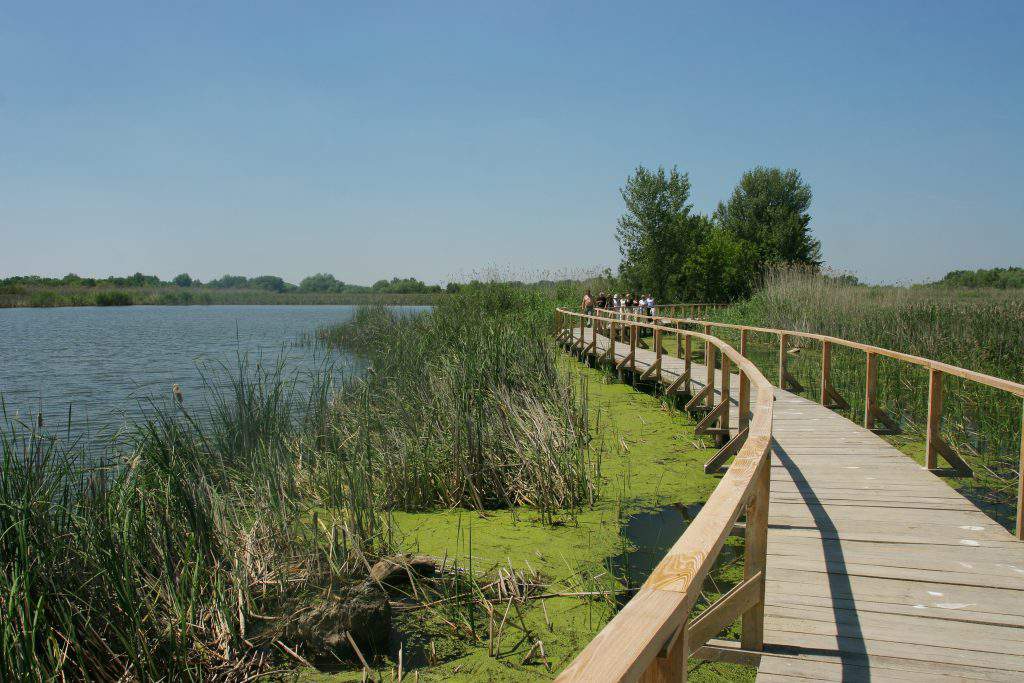
Poroszló. One and a half hours from Budapest, so an easy day trip if you need to be home by the evening. The admission fees are not cheap, but they offer programmes for half or even full days for the money. One of the main attractions is the water walkway built on planks leading through the marsh with its abundant aquatic plant life. For me, the most interesting thing was water chestnut, which covers a large area of the water surface. It is protected because this is the only place in Europe where it covers such a large area. It produces an edible crop that can be harvested around this time of the year and used to be eaten in the area of the River Tisza. It tastes like walnut when raw and like chestnut when baked.