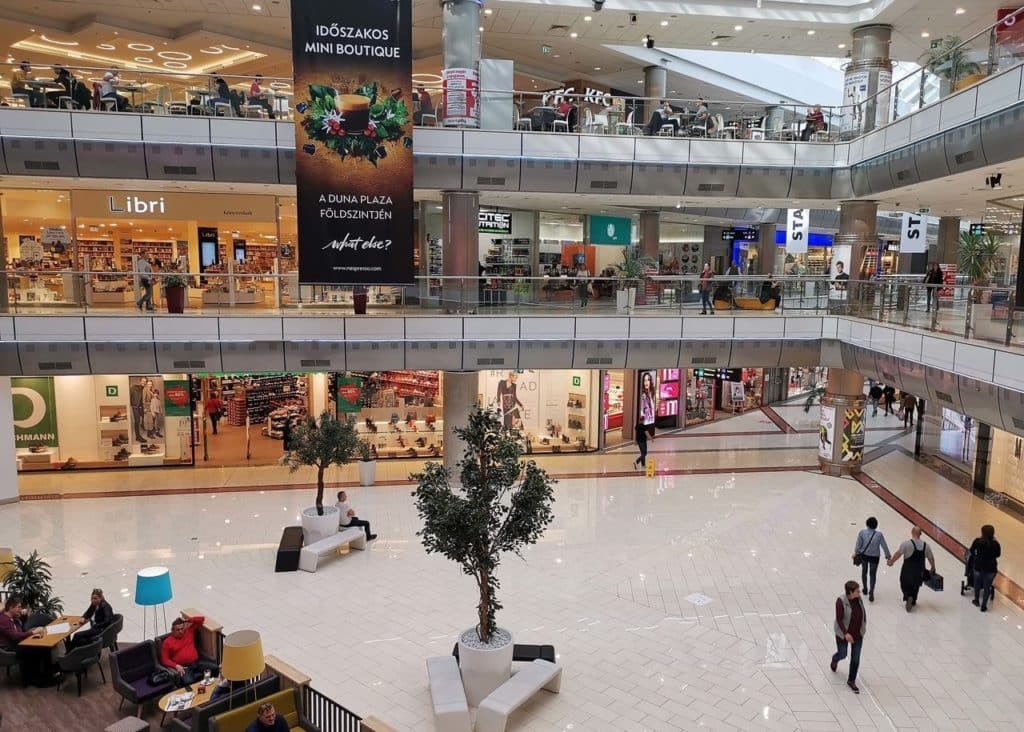
The Hungarian retail property market is undergoing significant changes, with new shopping centres opening and major renovations planned. The CBRE Hungary Market Outlook 2025 event, as reported by Portfolio, provided insights into the sector’s future, highlighting key developments in Budapest and across the country.
New malls and renovations
While large-scale shopping mall developments remain scarce, the focus has shifted towards renovations and optimising existing retail spaces, Portfolio reports. Erika Garbutt-Pál, Retail Leasing Director at CBRE, emphasised that the post-COVID period has been about portfolio optimisation rather than new constructions.
Two of the most significant projects currently underway are led by Indotek Group:
Duna Plaza in Budapest will temporarily close next year for a major renovation and expansion, reopening in 2028 with a total area of 50,000 square meters.
Alba Plaza, following a similar timeline, will also reopen in 2028 after extensive redevelopment.
Additionally, after years of planning, the Fórum Debrecen project is also progressing. Meanwhile, Budapest will see the opening of a brand-new shopping mall this year. Zenit Corso, an 11,000-square-meter retail centre in Zugló, is set to welcome visitors in October.
Retail growth and emerging brands
The Hungarian retail sector saw substantial expansion last year, with 160 new retail units opening—20% of which were restaurants and cafés. New brands are continuously entering the market, including Primark, Koton, Orsay, and Luxoya. Currently, around 28,000 square meters of retail parks are under construction across Hungary, made up of several smaller retail developments.
Optimism in the investment market
CBRE experts predict that Hungary’s commercial real estate market will stabilise and grow steadily by 2025. Economic growth is expected to be around 2-2.5% this year, supported by a more predictable global investment environment following key elections worldwide.
Investment confidence is on the rise:
90% of investors plan to invest at least as much as last year, if not more.
A 15-20% increase in investment volumes is expected compared to 2024.
The residential sector is predicted to lead investments in Europe (32%), followed by logistics (27%) and office spaces (16%).
In Hungary, however, the real estate market is still catching up to regional leaders like Poland and the Czech Republic. While Poland recorded EUR 2 billion in transactions in the last quarter alone, Hungary’s total transaction volume for 2023 was the lowest in 15 years. However, experts anticipate a recovery, with transactions reaching EUR 700-800 million in 2025.
Shifts in the office market
Budapest’s office market faces high vacancy rates, especially due to state-driven office developments. Without these, the market would appear more balanced. Currently, 530,000 square meters of office space are under construction.
Rental demand is increasing, with last year’s leasing activity reaching 500,000 square meters.
Sustainability is a growing priority, with tenants and landlords focusing on meeting environmental standards.
Office work is regaining importance, with two-thirds of companies now requiring at least three days of in-office work per week.
Challenges in the logistics sector
While logistics was one of the strongest-performing real estate segments last year, 2024 brings new challenges:
Decision-making among tenants has slowed down.
Vacancy rates, which dropped last year, may rise to 11% due to expiring short-term contracts.
Large relocations are freeing up significant space, creating hidden vacancies that are not immediately reflected in market statistics.
Despite these challenges, the flexibility of leasing terms has improved, and regional markets outside Budapest are attracting more activity.
Outlook for Hungary’s real estate market
Hungary’s real estate sector still requires price adjustments, presenting opportunities for new investors. Interest is growing from Mexican, Spanish, and South African investors.
The hospitality sector is gaining traction, potentially making up 20% of total real estate transactions by 2025.
Logistics remains stable, while the retail property market lacks high-value assets.
Office market liquidity is available, but investors remain cautious and selective.
Overall, Hungary’s real estate market is expected to recover further by 2025, with investor confidence strengthening and sectoral shifts shaping new opportunities.