Subscribe to our social channels to get the latest news about Hungary!


Jobbik leader Gábor Vona launched a signature drive for a European wage union at the party’s Aug. 20 event in Budapest. Parliamentary group leader of the ruling Fidesz party, Lajos Kósa, marking Hungary’s national holiday on Sunday, said St. Stephen’s legacy obliges Hungarians to follow the path marked out over a thousand years of its statehood.
At an event in Debrecen in southern Hungary, Kósa called Hungary “strong and independent; a Christian nation and a community of Hungarians who are always receptive but at the same time careful to preserve their culture, character, heritage and freedom.”
Lászlo Botka, the opposition Socialist party‘s prime ministerial candidate, said: “We must return to Europe”.
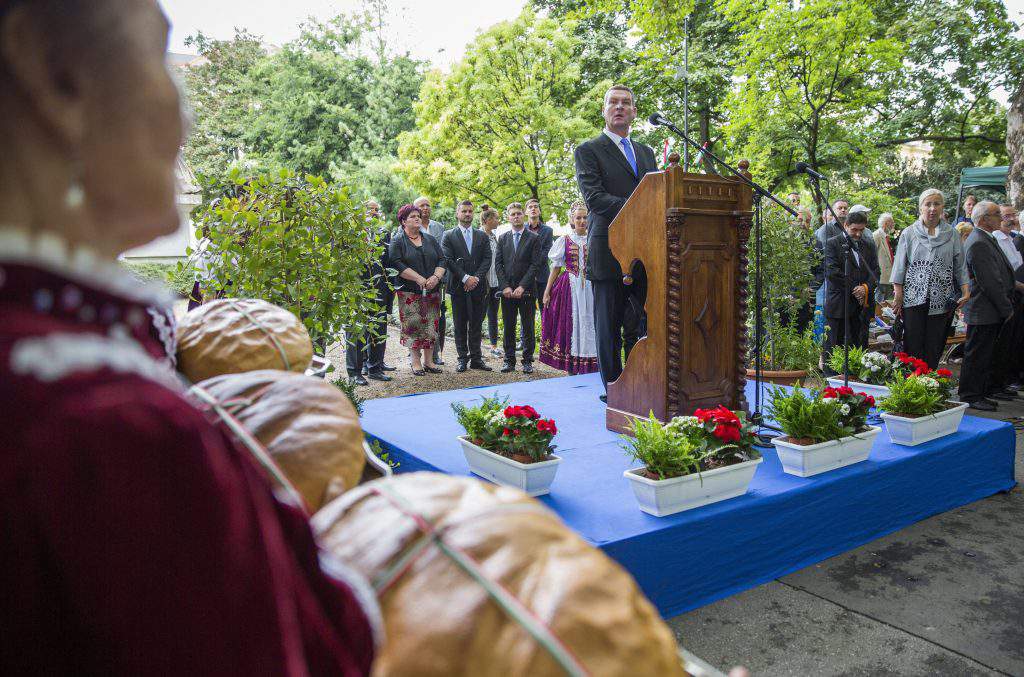
“We can be a happy and coherent nation of the Carpathian Basin only if we take greater responsibility within the borders and beyond,” Botka said in Szeged, the southern Hungarian city of which he is mayor. He said being a patriot means “protecting our historical and cultural heritage for future generations and once again uniting our divided society.”
As we wrote yesterday, at the demonstration in support of a free press and a change in government, Gergely Karácsony, Dialogue’s co-leader, told the crowd that after the 2018 general election, the state founded by St. Stephen, which had been destroyed several times over the past 100 years, would have to be reestablished.
According to Jobbik press office, on August 20, Gábor Vona officially launched the wage union initiative: as part of Jobbik’s Family Day held in Budapest City Park, the president of the largest opposition party asserted it was the EU’s vital interest to reduce the wage gap splitting our continent, also pointing out that Eastern Central European governments had a great responsibility not to miss this historic opportunity. By signing Jobbik’s wage union initiative, Mr Vona officially launched the project at the party’s family event on August 20. Before that, the prime minister candidate of the strongest opposition party introduced the campaign running in eight EU member states to achieve the adoption of “equal wages for equal work” into the EU Treaties as a fundamental right for citizens.
Addressing the critics of the wage union initiative, the politician pointed out that some of them might not have taken the trouble to actually read the document so “they have no idea what it is about”. He added that the wage union concept did not involve raising wages overnight. “This is a European reform project! Because something is wrong in the European Union,” explained Mr Vona, referring to the unfulfilled promise made to the newly-joined countries, i.e., that their wages would be closer to those of the western states. Talking about the EU being enlarged only to gain new markets and cheap labour in the east, he called it a system error.
However, the wage union concept has already proven to be feasible, as shown by the historical example of East Germany: the former GDR is now the 14th most developed region in the European Union. “If East Germany could make it, so should the entire European Union,” Mr Vona asserted, adding it was only a question of true intentions. Further explaining the East German example, he said the integration of the GDR did not make Germany weaker. On the contrary, Germans grew even stronger. As he put it: “The European Union will either adopt the wage union, or there will be no European Union at all.”
Stressing that the Citizens’ Initiative was the highest level of popular action in the European Union, and if there were an even higher one, they would have taken it, he asked the question: “But why do I, Jobbik, the opposition have to do this?” According to his answer, the reason is that the Hungarian governments of the past 27 years based our economy on cheap labour. “Let’s toy with the idea what would have happened if Viktor Orbán had come up with the concept of the European wage union! Would Jobbik back it? Yes!” This was his way to emphasize that reducing the wage gap was a non-partisan initiative, asking: “How could anyone have the cheek not to support the idea of Hungarian people earning decent wages?!”


