Subscribe to our social channels to get the latest news about Hungary!


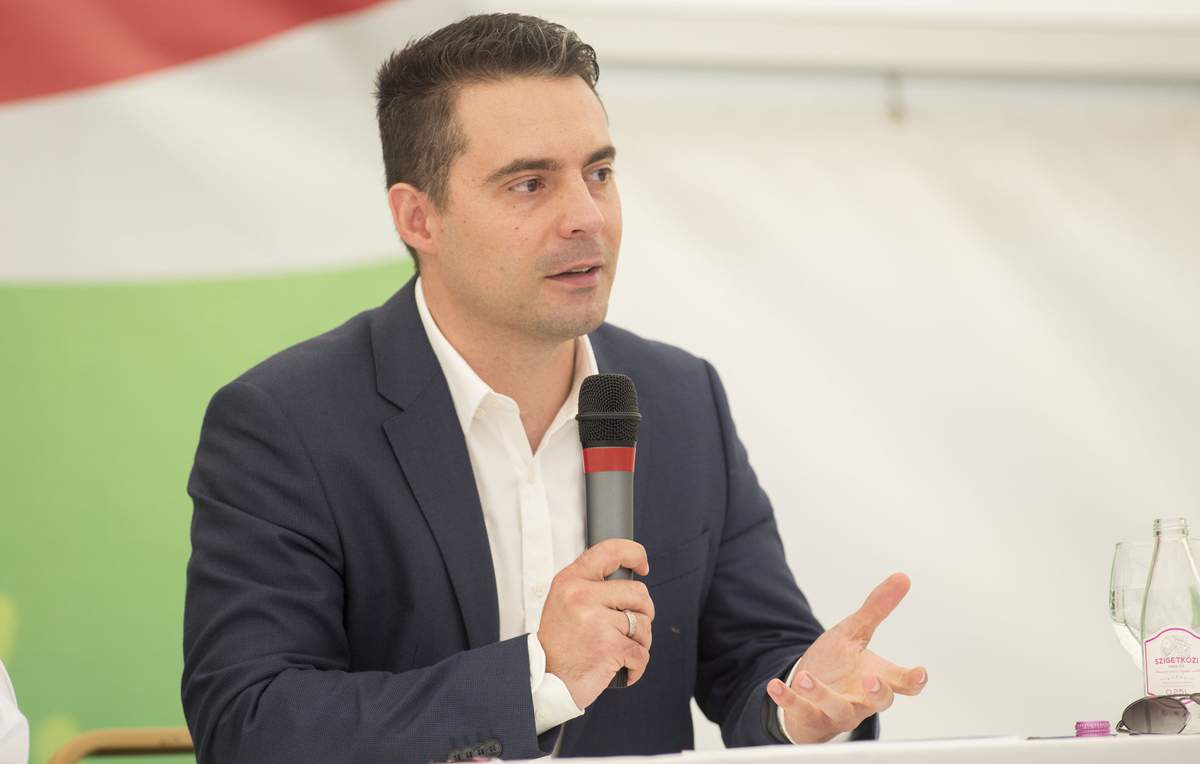
After last year’s meeting, Gábor Vona again invited intellectuals interested in his ideas and debate-launching speech. The meeting was held in the town of Soltvadkert on Saturday, with at least 150 participants. The purpose of the speech was to lay out the objectives of modern conservatism. Jobbik’s president emphasized the need for turning a losing attitude into a winning one and explained his views on how to take up the fight against hopelessness, misery and lack of freedom so that a proud, liveable and independent Hungary could be created. The president urges to build bridges within the society and is aware that he might fail his attempt. The list of participants was confidential but some of them did answer our questions about their experience.
Held in Soltvadkert’s Anna Restaurant and Hotel with a strict access control, most of the attendants were well-known and influential people with high positions in the areas of science, arts and sports, but their identity was not revealed to the public this year, either. As we were told, the reason for the confidentiality was that the purpose of the programme launched last year with the idea of establishing a tradition was not to build up a “Jobbik-related intelligentsia” but to enable real intellectuals interested in the thoughts of the leader of a prospective governmental force to get to know the party president’s objectives from a presentation specifically designed for them as well as to debate the presented ideas in the Q&A session or directly and freely discuss them with Gábor Vona or each other all day afterwards.
The Tapolca Discussion was a milestone
Last year’s presentation focused on positioning a national people’s party in a 20th-21st-century matrix, defining the role of a critical-minded Hungarian intelligentsia that is truly independent from all political parties and discussing the concept that the values of Christian conservative thinkers were better represented by Jobbik than Fidesz.
At around 10.30, László Szávay, the moderator of the president’s lecture and the follow-up discussion gave the floor to Gábor Vona who delivered his speech in front of a “We Build Bridges” banner, a key message of his State of the Nation Address held in January. The topic of the presentation, as Gábor Vona put it, was not to outline a party programme or a governmental strategy but to lay out the objectives of modern conservatism.
In his view, the token of survival for the Hungarian nation lies in modern conservatism as an approach to life. It is our ancestors’ spiritual knowledge combined with the problems and challenges of the present – this is how he defined the term.
The conference tent was filled with the participants, including current and former prominent representatives from nearly all professional areas and they could always feel involved in the interactive discussion just as Jobbik’s president had declared that the purpose of his speech was to launch a debate. The confidential ambiance indeed gave ample opportunity for constructive debates, which was highly appreciated by the participants, according to the repeated statements of the ones who answered our questions.
Hopelessness, misery, lack of freedom
“Hungary is dominated by a general bad feeling of suffocation.” This is how Vona began his speech, explaining that he had drawn this conclusion from his personal interactions with citizens during his tour of the country. As he put it, he also asked them about the reasons for these feelings and he was told that it was mainly misery (low living standards) and the lack of freedom that gave rise to these emotions. The party president complemented this picture with hopelessness which, in his view, significantly determines public sentiment.
He recalled the three adjectives that his party used for describing the kind of Hungary they wanted to work for back in 2003, when they founded Jobbik: proud, liveable, independent. He emphasized that these three characteristics are the positive counterparts of the country’s current state. Pride is opposed by hopelessness, liveability is opposed by misery while independence is contrasted by the lack of freedom.
Going on, he organized his speech along the topics of hopelessness, misery and lack of freedom, starting with the first one, which he called the ancient, debilitating curse that prevents any community from progress. It is best demonstrated in our daily lives by the public sentiment that politics cannot change, “you can’t really replace the government but even if you do, everybody keeps stealing”. In his view, all previous governments have always been interested in maintaining this attitude. He called this phenomenon “political trench warfare”, where citizens are either threatened that “if you don’t vote for us, the Nazis will return,” or “if you don’t vote for us, the Communists will return”. In his opinion, neither of these predictions have any credibility but the deep division keeps urging voters to choose between the lesser of two evils. Thus citizens can never feel there is a good choice, therefore the country keeps sinking back into the abortive confrontations of the 20th century.
Referring to this general hopelessness, he called it a mental distortion of the Hungarian nation, the reasons of which have been researched by so many thinkers all their lives. He also emphasized that analysis without a solution is not enough, i.e. the sentiment must be turned into hopefulness. This is not at all impossible, considering how enthusiastically the nation responds to any success achieved by creative Hungarian people, including the fervent reception of the national football team’s Euro campaign, the Olympics or “The Horsearcher” movie.
Taking risks and leaving the comfort zone
To solve these problems, you need to build bridges. You must leave your comfort zones, the war trenches. This is what the president does now, although he is fully aware that he might fail in his attempt.. The goals of his effort is to find out if a political community can step out of its own shadow and to make the community understand that he wants to represent them, but others, too.. “Is there a need for that at all?” He asked the pressing question which he illustrated with an expressive image. Building bridges is a tough thing, it might as well be called a radical act. Furthermore, people trying to connect two riverbanks are often accused by one side as “traitors” while those on the other side keep yelling “don’t you dare to come here”. In his view however, building bridges is the token of the Hungarian nation’s survival..
“Apart from us, who else would be willing to risk their political capital to attempt overcoming the nation’s hopelessness?” he asked, adding that, beside Jobbik, perhaps András Schiffer (the former co-president of the Politics Can Be Different party) was the only one who wanted to prove that “politics could be different,” but he finally failed due to the limitations within his own party.


I guess genius VONA screwed up this time, big time….