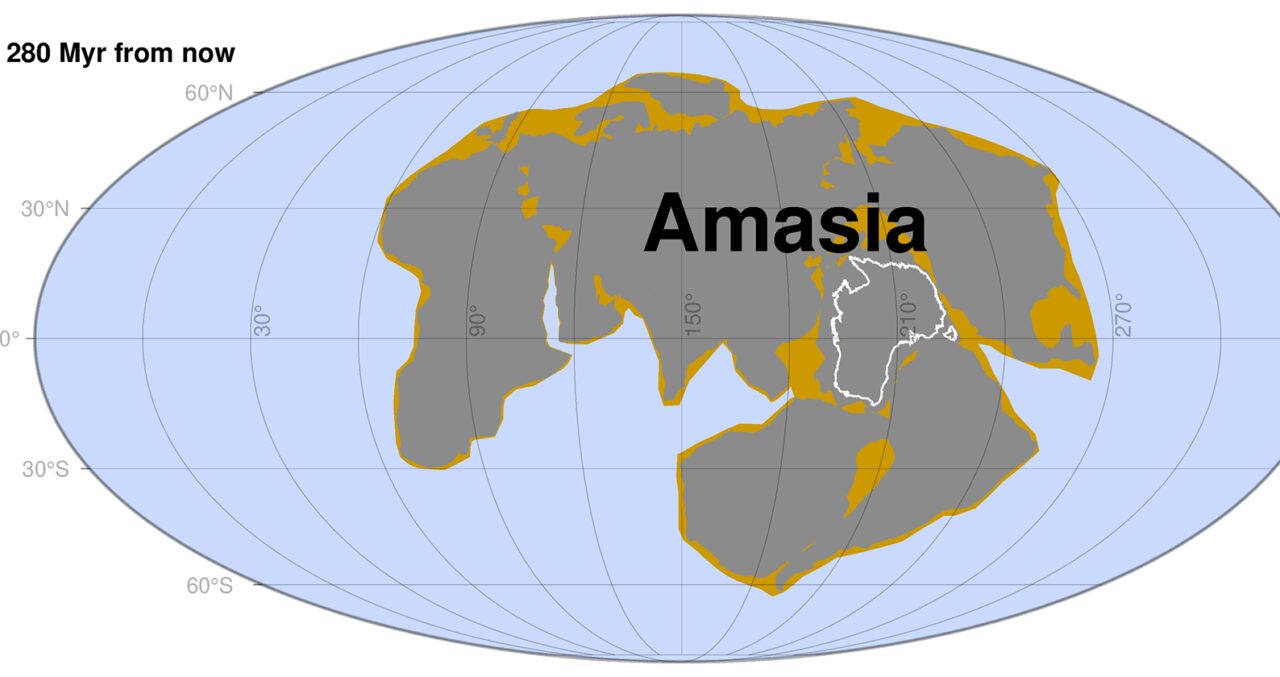
The Earth’s surface is in constant flux, even if we don’t feel it. Continents slowly but steadily drift, collide, and fracture — this is how ancient supercontinents formed, and how the next one might take shape. Based on multiple scientific theories and simulations, a new supercontinent could emerge within the next 250 million years, drastically transforming our planet.
Return to the age of supercontinents
The movement of continents is driven by the slow dance of tectonic plates. Over the past two billion years, three major supercontinents — Columbia, Rodinia, and Pangaea — have formed and eventually broken apart, according to IFLScience. Now, scientists believe the continents are drifting back together, setting the stage for a massive landmass to emerge, referred to as either Pangea Proxima or Amasia.
American geologist Christopher Scotese first proposed the concept of “Pangaea Ultima” in the 1980s, later renaming it “Pangaea Proxima”. According to his theory, the subduction of the Atlantic Ocean floor will cause the Americas, Europe, Africa, and Asia to merge into one enormous landmass, with Australia and Antarctica attaching to its southern edge.
The Pacific could disappear
Another theory, however, suggests that it’s not the Atlantic but the Pacific Ocean that will vanish, according to an earlier article from ScienceAlert. Researchers from Curtin University in Australia used supercomputer simulations to suggest that subduction zones in the Pacific (such as the infamous “Ring of Fire”) act like drains, shrinking the ocean by several centimetres per year.
According to their simulations, a new supercontinent named Amasia could emerge when North America collides with Asia. Despite not being named after it, Australia is expected to play a key role in “plugging” the Pacific Ocean.
A radically transformed planet
Whether Pangaea Proxima or Amasia comes to be, one thing is certain: Earth as we know it will change completely. Research indicates that the interiors of these massive continents will likely be dry and experience extreme temperature swings. Oceans may recede, sea levels could drop, and Earth’s ecosystems would face major challenges. A 2023 study even suggests that the harsh conditions of this new megacontinent could lead to mass extinctions among mammals — assuming humanity is still around by then.
Diverging paths, one direction
While scientists disagree over exactly how and where the next supercontinent will form — some theories place it near the equator (Aurica), others near the Arctic (Amasia) — they do agree that the process is inevitable. Earth’s surface is continually shifting, and over the coming millennia, today’s continents will converge once again.
The future Earth will be unlike anything we’ve seen: oceans may disappear entirely, new mountain ranges and interior deserts could develop. While these changes are slow and distant, they offer a revealing glimpse into the long-term fate of our planet.