Subscribe to our social channels to get the latest news about Hungary!


Researchers from the HUN-REN Institute of Experimental Medicine (HUN-REN KOKI) have identified a previously unknown area in the brainstem that plays a role in the brain’s reward system. This discovery could pave the way for new treatments for anxiety, depression, and even addiction. The findings of the research were published in Science, one of the world’s most prestigious scientific journals.
Our brain constantly evaluates whether our experiences are beneficial or harmful to us, guiding us in making appropriate decisions. In the face of danger, this process helps us escape, while it also enables us to choose our favorite coffee shops. The neural basis of this mechanism is a complex process regulated by numerous ancient and higher-order brain regions.
In the brains of mammals, the lateral habenula (a subcortical structure located in the diencephalon) plays a crucial role in processing emotions and regulating motivational processes. When the lateral habenula is activated, it triggers negative emotions, and its overactivation can lead to anxiety or depression. Conversely, when the lateral habenula is inhibited, it can evoke positive emotions, which may be significant in generating feelings of joy or treating mood disorders.
At the HUN-REN Institute of Experimental Medicine (HUN-REN KOKI), Gábor Nyiri and his research team identified one of the most significant brainstem excitatory neuron populations that activate the lateral habenula during negative experiences. This finding, published in Science in 2019, revealed that these excitatory cells trigger negative emotions and aggression.
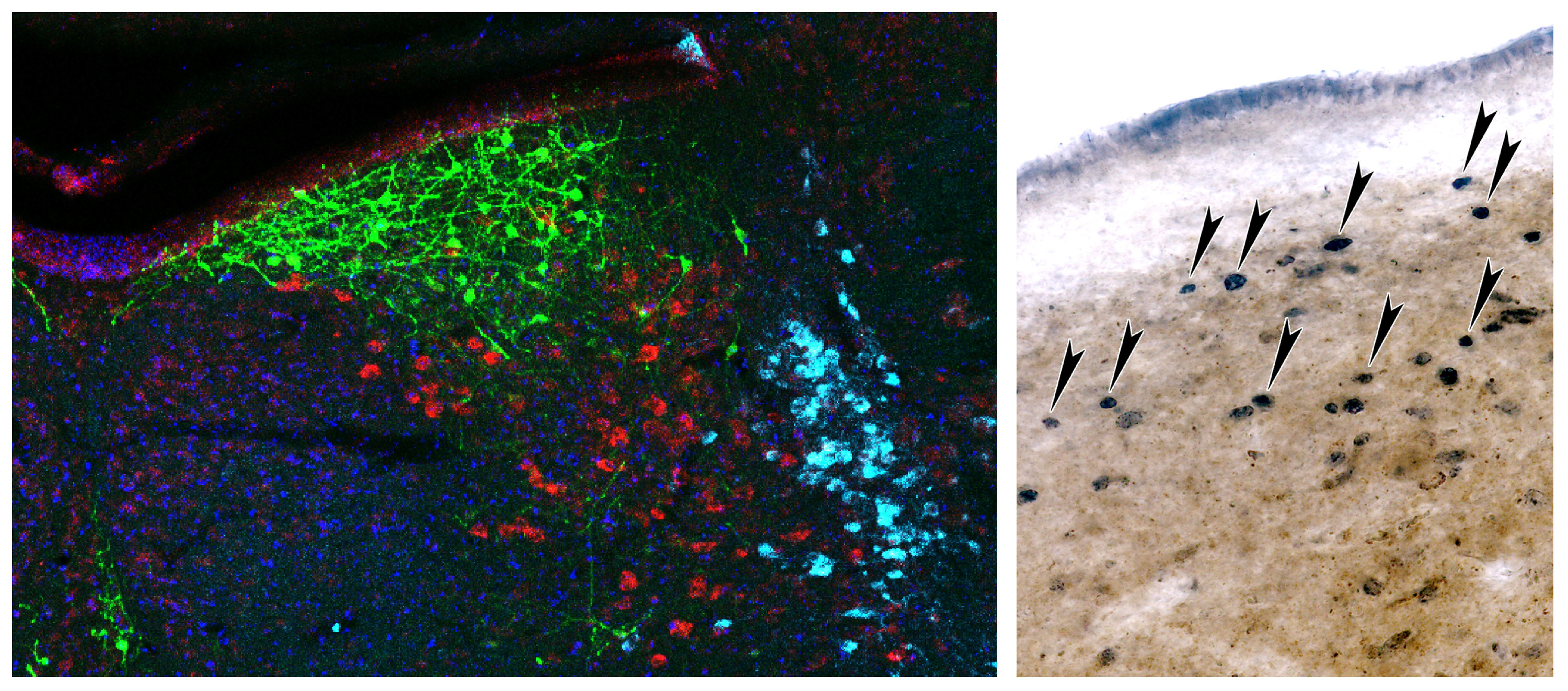
In their recently published study, researchers from HUN-REN KOKI, led by senior researcher Gábor Nyiri and including Krisztián Zichó and colleagues, discovered another, previously unknown brain region that targets the lateral habenula. Unlike the previously identified excitatory area, this newly identified region provides pure inhibition to the lateral habenula, making it the largest known brain region with this function.
Based on its location, this brainstem nucleus was named the subventricular tegmentum (SVTg). Its role in various neural processes was investigated in collaboration with Swiss and other Hungarian research groups.
In a series of experiments, the researchers trained mice to freely activate their own SVTg neurons by having them insert their noses into a small hole. The scientists found that the mice enjoyed this task and made repeated efforts to activate their SVTg neurons as often as possible. This demonstrated that SVTg activity generated positive feelings in the animals. From this, the researchers concluded that these cells likely play a role in seeking pleasurable experiences and, in humans, could potentially contribute to the excessive pursuit of pleasures.


Anxiety, depression and addiction are huge issues is societies all over the World. Discoveries that could lead into creating effective sciencific evidence based treatments for people with these issues are great achievements. Congrats to the team of scientists and keep up the good work!