Orbán at Budapest Eurasia Forum: Europe must adapt to Eurasian shift or face decline
Change language:
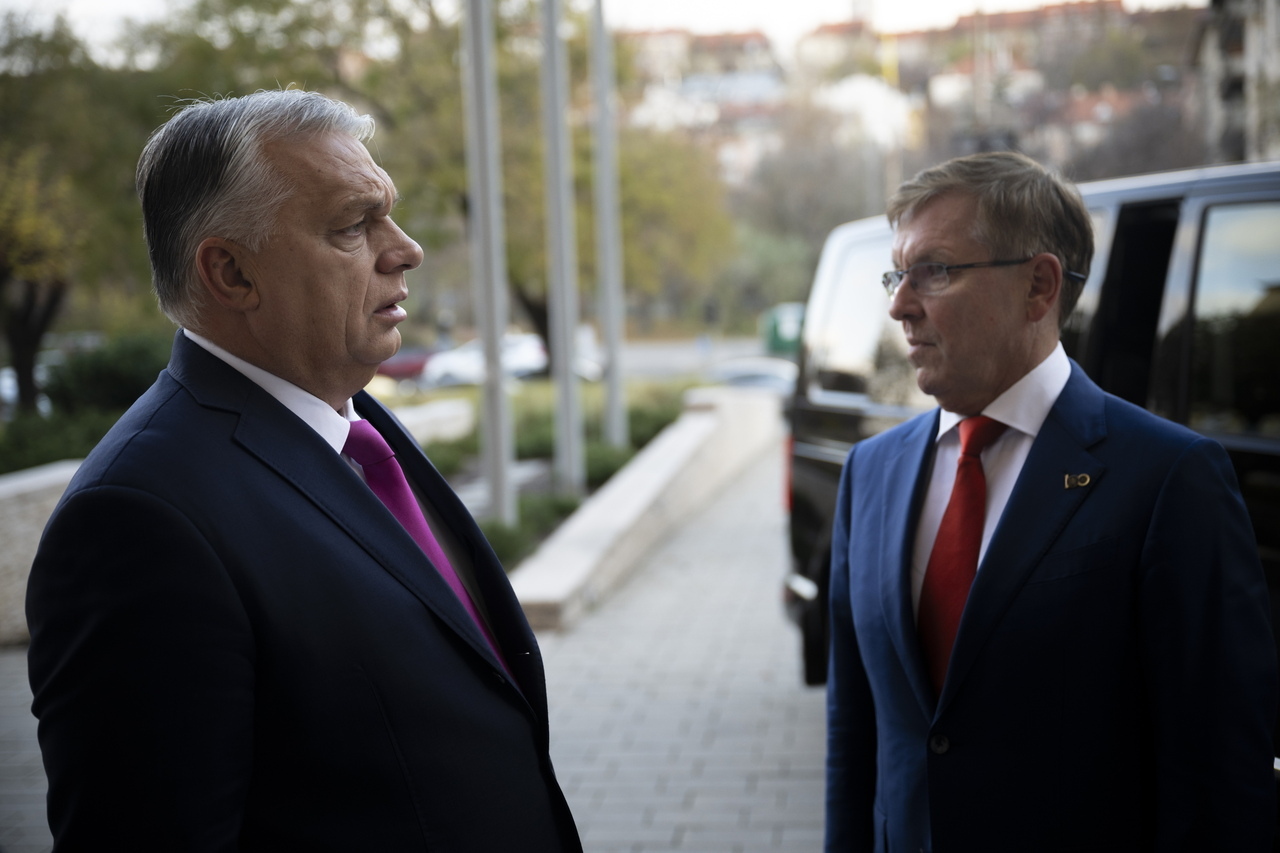
After the global financial crisis of 2008-2009, “it became clear that the West’s system of political and economic self-correction does not work,” Prime Minister Viktor Orbán said at the Budapest Eurasia Forum, adding that “new centres are emerging in the world, especially in Asia … as a result of which modernity is no longer an attribute of the West.”
Speaking at the National Bank of Hungary’s Eurasia Forum in Budapest on Thursday, Orbánsaid the first years after the political regime change of 1989 had been dominated by the ideal of the Western self-correction system which was believed to “guarantee our strategic security in the long run”. But in 2008-2009 it became obvious that “the financial crisis was in fact a logical consequence of deep changes in the global economy radically impacting geopolitical relations,” the prime minister said. That is why, Orbán added, Hungary’s focus has partly shifted to the East.
Photo: MTI/Miniszterelnöki Sajtóiroda/Benko Vivien Cher
Hungary ‘must be sharp, swift, smart’
Hungary must be “sharp, smart and swift”, open to the world and “must constantly think on its feet to grasp the right moment for necessary decisions”, Orbán said. “Timing is the main thing in politics … politics is the realm of practical implementation, and that hinges on timing,” Orbán said. “For a country the size of Hungary, missing the right time could be lethal.”
“A country the size of Hungary can’t be slow, dumb or boring, it cannot be a follower or rely on others’ understanding or interpretation … if it wants to live at the standards we want and live up to traditions like our 1,000-year history, it must be sharp, swift and smart, open to the world…” he said.
Europe ‘losing out on world changes’
Europe is losing out on the changes in the world, and “it could remain that way in the long run unless it finds its place in its relationship with Asia,” the PM said. “If it is true that the next century belongs to Eurasia, we must notice that Europe can’t find its place in that system,” Orbán said. He said some Western leaders failed to see Eurasia’s importance, while others “see it but don’t like it”.
He said the European elite was set up to protect the status quo, which could lead to blocs forming in trade, the economy and politics. Unless Europe can pivot to an approach promoting connectivity, its status as the loser in the new processes could be cemented, he said. “Europe must understand that it is part of Eurasia and use that to its advantage, as that is the only way to be competitive with other power hubs in the world,” he said.
Current changes ‘reversal rather than restructuring’
“What is happening nowadays is reversal rather than restructuring,” Orbán said, adding that “Europe and Asia in fact are an integral unit”.
Europe and Asia are not divided by geographical borders and historically, they have formed “a natural economic unit, complementing each other”, Orbán said. “Regions where civilisation, culture and economy thrived the most lived side by side here,” Orbán added.
Eurasia, as a natural economic unit, was hindered in past centuries by the focus of world trade shifting to the seas, and in the resulting dominance of Western civilisation, he said, adding that the trend removed a balance between civilisations to the West’s benefit. A third hindrance, Orbán said, was the Western elite’s decision after the Cold War “not to restore an organic Eurasian unity but to westernise the whole world”.
“We all feel that this attitude, this Western strategy, including Europe’s, is invalid and futile; something has ended here,” he said.
‘Century of Eurasia’ to come
Eurasia will dominate the next period, and Hungary will have to find its place rather than derive it from a European strategy, Orbán said. Hungary “is consciously implementing national and economic policy, where the fact that the country lies in Eurasia is a determining, albeit not exclusively important, factor,” Orbán said.
“We are the living Eurasian concept … as a people coming from Asia,” Orbán said. He said Hungary’s conflict with the European Union was rooted in its independent strategy founded on new realities and the recognition of a new set of opportunities “regardless of the Brussels doctrine”.
Matolcsy addresses Budapest Eurasia Forum
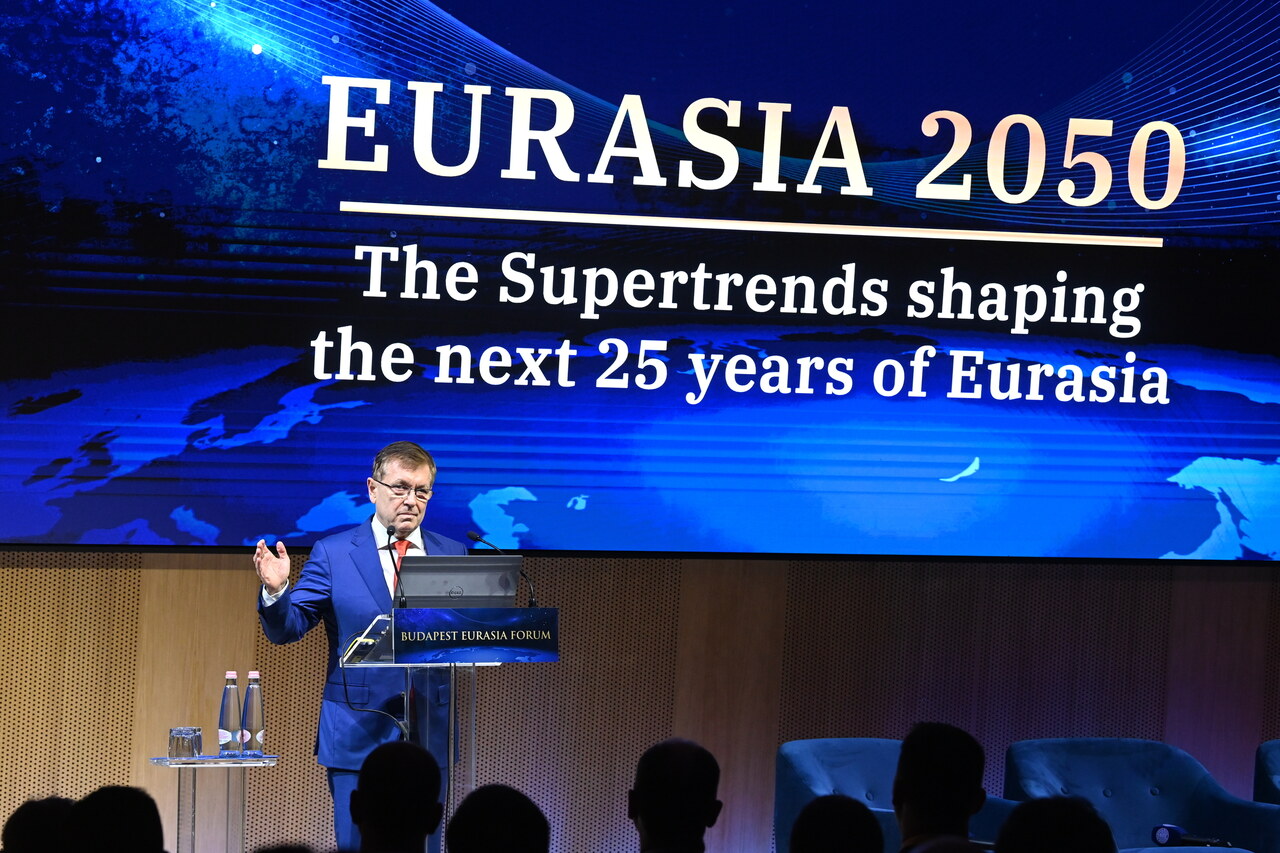
A new Europe can be born in the 2030s by reshaping the relations between member states, based on a new agreement, National Bank of Hungary (NBH) governor György Matolcsy said, addressing the fifth Budapest Eurasia Forum. Matolcsy said Hungary could play a leading role in a new, looser European organisation, creating a good merger of East and West, a new European Common Market.
Photo: MTI/Máthé Zoltán
The next 25 years, Matolcs said, will bring a world of wider opportunities in the areas of information, energy, finance and knowledge, while risks will also be stronger with climate change, new wars, social tensions and artificial intelligence. This duality must be exploited, he said. These years will be defined by the three big supertrends of geopolitics, strengthening climate change and the technological revolution, he added.
Calling for a change of strategy, Matolcsy said Europe should break with the idea of creating a United States of Europe and give up the vision of a global power and establish a new, horizontal network instead. Then high efficiency could replace the current low efficiency, he said.
The title of this year’s forum, “Keywords of success: talent, knowledge, technology and capital”, reflect the changes that have taken place in the economies over the past hundred years, while also showing the way to the future, the NBH said. Today, the most successful countries are those that can build the right combination of knowledge, technology and capital, driven by talent, which requires a supportive education system.
The Budapest Eurasia Forum 2024 once again brings together influential decision-makers, entrepreneurs, business leaders and academics to exchange opinions on the inevitable changes necessary to achieve sustainable development and to discuss the most pressing questions of our time, the NBH said.
Hungary’s room for manoeuvre ‘widened greatly’
Hungary’s room for manoeuvre has been greatly expanded in the past year, which has strengthened Hungarian communities across the borders, Prime Minister Viktor Orbán told a plenary meeting of the Hungarian Standing Conference (MÁÉRT) in Budapest on Thursday. The government has ploughed 1,374 billion forints (EUR 3.3bn) into policies supporting Hungarians across the borders, raising tenfold the support of the pre-2010 era, he told the meeting.
Additionally, it has spent 330 billion on 9,300 investments in the Carpathian Basin, he said.
Orbán said 2024 had been “the fullest year yet in the history of Hungarian diplomacy”. The Chinese president visited the country in May, Hungary recently organised a summit of the European Political Community and an informal summit of the 27 European member states, which adopted the Budapest declaration, “possibly the last attempt to save Europe’s competitiveness”, he said.
Through the US and European parliamentary elections, as well as the year’s successful diplomacy, Hungary managed to widen the scope of its foreign policy, he said.