Subscribe to our social channels to get the latest news about Hungary!


In the latter half of the 19th century, the contrast between Hungarian national aspirations and Romanian goals for sovereignty was evident in how the two groups perceived each other. Proud, mistrustful, hasty and overly patriotic—these and similar stereotypes about Hungarians were common among the Romanian population.
At a conference titled “Images of the Nation: Hungarians about Romanians, Romanians about Hungarians from the 19th Century to the Present Day,” hosted by the Institute for Minority Studies of the HUN-REN Research Centre for Social Sciences, experts discussed the Romanian image of Hungarians during the dual monarchy of Austria-Hungary (1867-1908), according to 24.hu.
Following Hungary’s liberation from the Ottoman Empire in the late 1600s, the country’s territorial unity remained fractured. The Kingdom of Hungary existed within the Habsburg Monarchy, while the Principality of Transylvania (Partium) remained a separate entity within the Habsburg domain until the 1867 Ausgleich, which established Austria-Hungary. Despite this, the cultural lives of these territories were deeply intertwined.
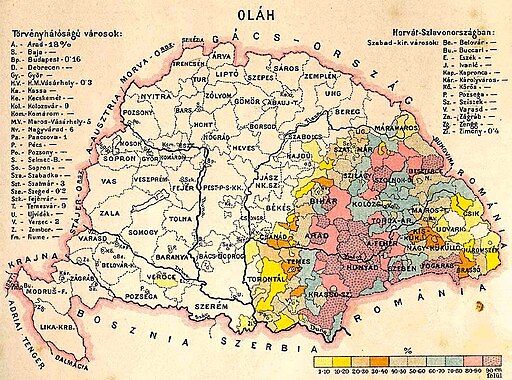
In the 19th century, national pride and the conceptualisation of the nation as one fighting for its freedom were central to Hungarian identity. According to 24.hu, for many, it “only took a step or two to disparage, and often even despise, the non-Hungarians living in the country.”
Count Dénes Esterházy exemplified this attitude, to the disapproval of many Hungarian political figures: “In Transylvania, only the Hungarian is human; the Vlach can and must be treated like a brute.”
National movements aimed at unifying Hungary and Transylvania and achieving linguistic-cultural assimilation. The Hungarian political elite believed that the national minority population would be willing to become Hungarianised, or at least accept Hungarian as the language of public life. When Lajos Kossuth was warned of the problematic nature of this assumption, he confidently accused his critics of “pettiness.”
In a parallel process, from the 18th century onwards, a Romanian national awakening occurred, leading to demands for equal rights for Romanians in Transylvania by the end of the century, including the use of their language in official matters.
By the end of the 1800s, nationality politics and the question of how to manage relations between ethnic groups (including the Transylvanian Saxons) had become significant issues in the region.


Are we talking about gypsies here? Hungarians have every right to be a proud people.
And, according to Andrew Balogh, Hungarians have every right to be a racist people.
The way i see many Hungarians is, they are so selfish. If you dont help Hungarians first, they are not going to help you. Besides, most of them are so close minded, in a way that they are no willing to change its mind even when you have a solid point of view.
About upending the negative views of Hungarians some would prefer to believe, I see the Hungarian as a kind, hospitable, modest mostly, and even a noble people. And superbly intelligent:
THE MARTIANS – A TRUE STORY! https://andrewgbenjamin.substack.com/p/the-martians-a-true-story
Without a Hungarian’s fingerprint on everything that you touch, and everything that touches you, communications between us over the Internet would have been impossible. Without a Hungarian’s fingerprint on your lives, you’d still be living in the early 20th, and not 21st centiry.