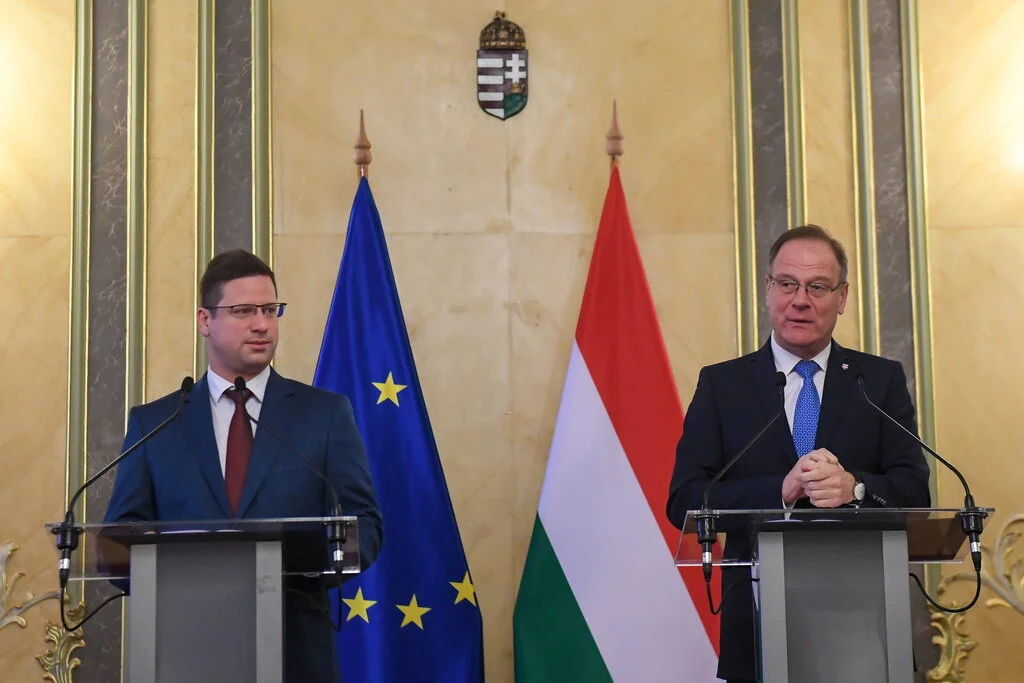
The government’s goals set in June have been fulfilled, Tibor Navracsics, the regional development minister, said after European Union ambassadors on Monday sent a proposal to the European Council to approve Hungary’s recovery plan and unblock its recovery funding.
Also, the goal was to strike a deal with the European Commission on cohesion funding by Dec. 31 to ensure that Hungary does not lose any of these monies, Navracsics told a press briefing on Tuesday, adding that agreement was reached. Navracsics said he trusted that the partnership agreements on the recovery fund and the operative programmes would be signed within days. Monday’s decision means that Hungary, like other member states, would be able to access EU resources. Under the arrangements of the RRF, access to some 5.8 billion euros will be available to Hungary, he said, while by the end of 2027, some 14,000 billion forints can be accessed, including for operative programmes with Hungarian co-financing.
Some 48 percent of the monies involved in the RRF will be spent on programmes that help achieve climate and energy policy goals, while 30 percent will enable the development of digital infrastructure and public services and supporting companies’ digital transition, he said. Concerning the monies available under the arrangements of the operative programmes, more than 4,000 billion forints have already been approved by the EC for agricultural and rural development so 9,000-10,000 billion forints will be left for other areas, depending on the exchange rate, he added.
Hungary maintained an open strategy at the talks, he said, adding that the government had given serious consideration to all requests and concerns coming from the Commission, and it was open to compromise if a good solution was offered. Accordingly, an agreement was reached with the EC concerning the rule-of-law procedure by September, allowing the sides to focus on the talks concerning the two large funds, and this brought about results by late November, he said.
At the end of November, the EC said that it considered Hungary’s national recovery plan “excellent” and saw no further concerns regarding the cohesion funds, either, he added. The current development demonstrates the Council’s recognition of the efforts made so far, he said. In response to a question, he said the last stage in the schedule of implementation was at the end of March and then the package of laws will have to be approved by Hungarian parliament. The EC said that if the end-of-March deadline is sustainable, then the freezing of funds can be lifted in April or May, he added.
He said he trusted that there would be no further demands by the EU. Continual dialogue has been maintained with the EC, and the milestones currently achieved demonstrated that Hungary’s efforts had been recognised, he said. The government will make an effort to clarify any possible problems raised during the talks with a view to preventing the need to raise any further demands, he added. Navracsics said there was no date set as yet for the signing of the partnership agreement. Monday’s deal had to be reached first and now within a few days, the date of signing the agreement will be announced, he added. The plan is to announce 25 new tender invitations by the end of March, he said.
Commenting on the loan part involved in the recovery fund, he said there were six months left to decide whether a loan would be taken out or not. The government will make its decision depending on the economic environment at the time, he added. Commenting on the milestones set for Hungary during the EU talks, he said Hungary had a good chance of showing an example to other member states how to “handle an ideologically driven campaign of hysteria” by means of substantive measures, and how to make further steps in the areas of public procurements and the whitening of the economy.
The future and legitimacy of the rule of law procedure will depend on how it can be kept at a distance from current politics and party politics, he said. The problem is not that the EU wants to protect its budgetary and financial interests, but the mixing of political considerations with legal ones, he said. Gergely Gulyás, the prime minister’s chief of staff, said the series of talks had resulted in a victory for the European Union; and “we are also a member of the European Union”. Maintaining European unity is especially important in the current situation, he said. Gulyás also said that anti-corruption measures did not harm Hungary, and the situation concerning corruption was not worse in the country than in western Europe or countries that joined the EU more recently.
Read alsoMinisters shared details about how Hungary will get the EUR billions from the EU
Navracsics said that the fact that Hungary will adopt the global minimum tax does not mean that taxes will increase. As part of a deal with Brussels, an existing business tax would be seen as part of the general tax burden, so in Hungary’s case the corporate tax would not have to increase. Gulyás added: the European Council put it in writing that the adoption of the global minimum tax would not force Hungary to raise taxes in addition to the current tax system, and the business tax could be incorporated.
Navracsics said the government had relaxed its previous objections to the global minimum tax when it became clear that the tax, which would have been harmful to Hungary in terms of increasing the tax burden and denting its competitiveness, would not result in a tax increase in the country. The global minimum tax in Hungary will affect several large companies which will have an additional tax payment obligation, but the system is being cleverly structured, Gulyas said.
Meanwhile, on the subject of the EU loan to Ukraine, Gulyas said Hungary’s standpoint was that there should be no further joint borrowing, “and we succeeded in finding a solution which doesn’t oblige us to borrow further”. Hungary wanted Ukraine to have bilateral arrangements, but Ukraine preferred the simplicity of getting the funding all in one go, he said, adding that the EU found a satisfactory solution by setting aside 18 billion euros of support within the EU budget.
Regarding dissatisfaction in the teaching profession, Gulyás said that as soon as EU funds are unlocked, the government will be able to increase the salaries of teachers. If operational funding is released on Jan. 1, then a pay increase will be implemented immediately, but this depended on whether the Commission would demand additional conditions. He added: “However large the European Parliament’s corruption scandal is, the Commission is afraid” of the EP, even though it was clear that the left wing in the EP had come under serious external influence and was embroiled in corruption scandal.
Asked about funding originating in the US to support independent media and civil organisations in central Europe, Gulyas said sovereignty must be respected, and the government of another democratic country and the question of who sits in its parliament should not be determined in Washington, Berlin or Moscow. Asked about Hungary’s ratification of Finland and Sweden’s NATO membership, Gulyas said that on Feb. 20, the first day of parliament’s spring session, the chamber will consider the question as part of its normal schedule, and the government would not be able to address it by decree using its emergency powers.




Politicians banging on about “ideology” and then riding their 9 percent corporate tax rate into the sunset.
Again. The global minimum tax is a global deal to ensure big multinational companies firms with 750 million euros in sales globally to pay a minimum tax rate of 15 percent and make it harder for them to avoid taxation. It should also put an end to decades of tax competition between governments to attract foreign investment.
At no point was Hungary at risk of having to increase taxes. If we would not charge these big international firms, other countries would do it for us. It was all about leverage and showing off to some major MNCs – and everyone knows it.
I wonder what facts Mr. Gulyás bases his statement the corruption situation in Hungary is ” not worse … than in western Europe or countries that joined the EU more recently”.
Lovely little interactive map: https://www.transparency.org/en/cpi/2021
The whole notion of hálapénz may be on the way out – but only slowly!