Subscribe to our social channels to get the latest news about Hungary!


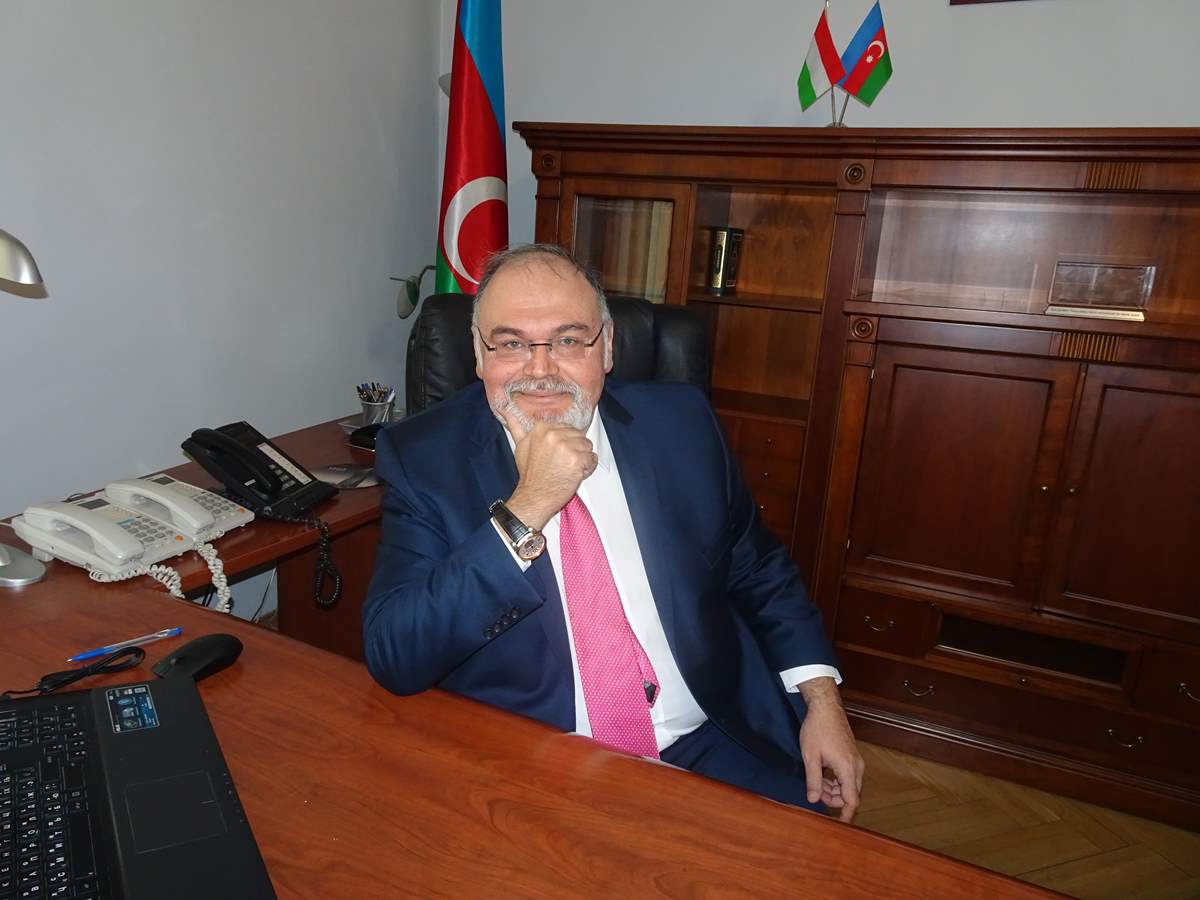
The relationship between Hungary and Azerbaijan is a very special one, and we thought that by getting to know the Ambassador of the Republic of Azerbaijan to Hungary H.E. Mr. Tahir Taghizade we could gain a better insight into the life of the Ambassador of Azerbaijan. Exclusive interview:
Daily News Hungary (DNH): Let’s go back a little earlier. What was your first thought when you learned that you would be delegated as ambassador to the Hungarian capital?
Ambassador H.E. Mr. Tahir Taghizade: Hungary is a brotherly country to Azerbaijan. We share common historical roots, values, and traditions. Three of the ten tribes that formed the Hungarian nation are of Turkic origin. Even the country’s name possibly derives from “On-ogur” (“Ten arrows”). In the letters addressed by the Byzantine emperor to Árpád, the first head of the confederation of Hungarian tribes, he was called “the prince of the Turkic tribes”.
It is interesting that having spent 12 years of my diplomatic career in neighbouring Czech Republic I have never visited Budapest before. Now, I can see what I missed.
We are strategic partners cooperating in diverse areas. It is an honor and privilege to represent my country in one of the most beautiful capitals of the world.
DNH: You have met many locals since your appointment. What is your impression of Hungarian people?
Ambassador Taghizade: It is impossible not to notice similarities between our nations. The hospitality of your people reminds me of my compatriots. It is especially pleasant that even if you meet a Hungarian person for the first time, they say that you can call them at any time and they mean it sincerely not just out of politeness.
I highly appreciate the locals’ friendly attitude towards Azerbaijani students and members of our diaspora.
DNH: In diplomatic terms, the Hungarian and Azeri governments nurture a good relationship. What concrete results has this amicable connection produced in the last year?
Ambassador Taghizade: As mentioned earlier we are strategic partners. The friendly working relations between our leaders play an important role in the cooperation. I also wanted to underscore that the current chairmanship of the Azerbaijan-Hungary Inter-parliamentary Working Group is on the level of the First Deputy Chair of the Milli Majlis. This already reaffirms our commitment and appreciation for bilateral relations.
I have been serving as the Ambassador of Azerbaijan to Hungary since September of last year and with great satisfaction, I can state that fortunately, life is getting back to normal after the pandemic which allows us to organise a number of events.
In early February, the 8th meeting of the Joint Commission on Economic Cooperation between Azerbaijan and Hungary was held in Baku.
Also, representatives of 24 Hungarian firms, accompanying H. E. Mr. Péter Szijjártó, the Minister of Foreign Affairs and Trade of Hungary, attended the Hungarian-Azerbaijani business forum.
We are firmly engaged in involving Hungarian companies in the reconstruction and rebuilding of Karabakh.
We have recently celebrated the 30th anniversary of the establishment of diplomatic relations between Azerbaijan and Hungary. A tree-planting ceremony was held in the botanical garden of Sopron University and a photo exhibition was opened in one of the central parts of Budapest, Hunyadi Square.
Most recently, on 27 May, the National Day of the Republic of Azerbaijan was celebrated in Budapest.
I had the personal privilege and honor to welcome the Deputy Speaker of the National Assembly, Mr. Sándor Lezsák to our event, and his words have further re-encouraged me in terms of the importance that Hungary attaches to our bilateral relations.
We look forward to further deepening our mutually beneficial cooperation.
DNH: Budapest gives home to an outstanding cultural meeting point, namely the Azerbaijan House in Hungary. What programmes do the organisers offer to the visitors?
Ambassador Taghizade: Azerbaijan House in Budapest was opened with the support of the State Committee on Work with Diaspora of the Republic of Azerbaijan and plays an important role in bringing together members of Azerbaijani Diaspora living in Hungary, as well as in the region of Central Europe.
Diverse cultural events, language courses, and gatherings dedicated to the special days of Azerbaijan are regularly held in Azerbaijan House. On 30 April 2022, a photo exhibition titled “Armenian vandalism: before and after occupation” was organised there.
Moreover, Azerbaijan House in Budapest opened its doors to Azerbaijani refugees fleeing from Ukraine when they were in need of accommodation.
We closely cooperated in providing safe travel to our compatriots and their family members to Azerbaijan.
DNH: Azerbaijan emerged victoriously from the Nagorno-Karabakh war in 2020. However, in the last one and a half years, there have been minor military clashes and the diplomatic scene has been quite tense in Armenia. How can you currently describe the recaptured territories? What kind of developments has Nagorno-Karabakh seen since it was reconnected to Azerbaijan?
Ambassador Taghizade: As I usually said in my interviews during the 44-day Patriotic War, for us it was not about winning a war, it was about winning a lasting peace. So let me tell you what has been done in this respect.
First of all, I should mention that according to the relevant decree of the President of the Republic of Azerbaijan, Karabakh and East Zangazur economic regions have been established in the liberated territories of Azerbaijan.
Demining process is still going on. However, the reconstruction and rebuilding of the regions continue successfully.
A fully functional airport was built in Fizuli within only 8 months. Two more airports are in the development process or under construction in Zangilan and Lachin. The “Victory” road to Shusha has been completed. “Smart villages” are to be created in the liberated territories. Moreover, Azerbaijan focuses on the renewable energy potential of these regions and aims to apply the green energy concept.
The activities carried out in the liberated territories serve as a litmus test, which will be implemented in the whole territory of the country.
In addition, some events are already being organised in Shusha, the city with the centuries-long status of the cultural capital of Azerbaijan. This year the city has hosted the Khari Bulbul Music Festival for the second time after its liberation. Representatives of diverse ethnic groups living in Azerbaijan presented their national dances and songs during the festival. Once again, we have demonstrated the multicultural nature of our society and our deep respect towards the rights and values of all citizens of Azerbaijan regardless of their ethnic background or religious affiliation.
It is noteworthy to mention that