Subscribe to our social channels to get the latest news about Hungary!


Hungarian culture is very rich in folk traditions. Many holidays and festivals originate from Christianity, but many come from the early pagan beliefs of Hungarians; furthermore, these two are frequently mixed. In this article, I would like to introduce some probably less-known traditions of the late Autumn and the Winter season.
If you are interested in the full list of Hungarian Autumn traditions, you can find it in this article. Since the majority of agricultural activities ended by Autumn, for women, it was the period of weaving. For now, I would like to talk about the last two in November.
This is both a day of predicting and forecasting weather and a day of love charm. Dancing and celebrating were not allowed, and the next major traditional event is the Advent period. In some areas, bachelors were fasting all day to make themselves dream about who would become their wife. Maidens also tried to figure out whether they would become married. They put twigs in water, and if the twigs of the fruit trees would sprout or blossom, they will be married next year. The saying that is used to predict weather goes like this: “Katalinkor kopog, karácsonykor tocsog”. This means that if the weather is freezing on this day, i.e. there is hail (kopog means to knock or bang) then the weather at Christmas time would be mild and it will rain (locsog means to splash), but the opposite is also true.

This day was also one to forecast weather and a day of love charming. On this day it was the maidens who were fasting (they only ate 3 grains of wheat and drank three drops of water) and before they went to bed, they put an item of man’s clothing under their pillows so that they would literally dream up the identity of their future husband. The bachelors could use this trick if they put a mirror under their pillows. Maidens also used the gombóc method. They would put the names of the bachelors of the town into dumplings and would boil them. Whichever dumpling came up first the bachelor, with his name in the dumpling, was meant to become their husband. Concerning the weather, it was on this day that the floating watermills had to be pulled to the harbour.
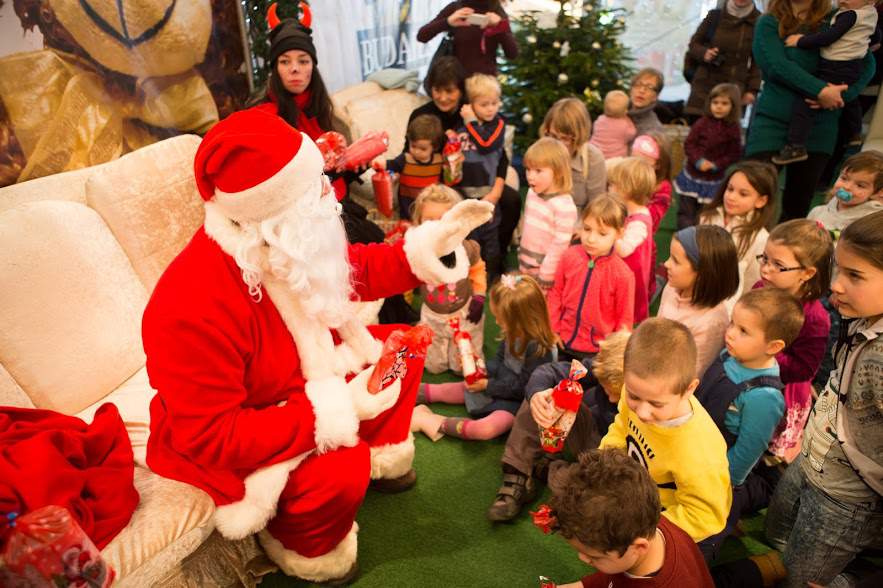
It is one of the youngest Hungarian traditions, a version of Saint Nicholas. While many believe it is Santa Claus who brings the presents on Christmas day, according to Hungarian folklore Santa Claus — called Mikulás in Hungarian — comes earlier. We celebrate him on the 6th of December. Szent Miklós is the guardian saint of children and pupils in Hungary. Celebrating this day usually goes like this: children will need to put a clean shoe or boot out in their windows, and they would receive small presents, candies or szaloncukor and some fruits and nuts (similar to stocking stuffers). In schools and kindergartens, there is usually someone who dresses up as Mikulás, and another person will dress up as a Krampusz or devil. Mikulás would give the mentioned little packages to good children, while the Krampusz would give a small bouquet of twigs called virgács to spoiled children.
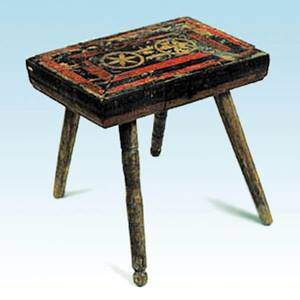
The day of Luca or Luca day is also an important day in Hungarian folklore. There are many interesting beliefs connected to this day; the most well-known is probably the carving of the Luca chair. The Luca chair was made from Luca day until Christmas day, and the maker of it would be able to see the witches at the midnight mass if they stood on it. There are different sources concerning how a Luca chair is made. When I was younger, I learned in school that it is made from 13 different types of wood and no nail can be used. Also, it is a three-legged chair. Other sources would indicate that it is made of 9 kinds of wood and it forms a pentagon. One thing is the same according to most sources; the maker could only do one procedure a day and Hungarians have a saying that goes: “It is made slowly like the Luca chair”.