5 interesting facts about Hungary’s largest and oldest national park
Photo: www.facebook.com/KardosIldikóPhotography
Change language:
The Hortobágy National Park might be one of the most well-known national parks in Hungary. The first thing that comes to mind for many people is the Nine-Hole Bridge, but the national park is much more than that.
It consists of 4 protected landscape areas and 19 independent nature reserves. The 800 km2 national park in eastern Hungary was founded on January 1, 1973. You will not regret visiting the park. With its diverse flora and fauna and many other treasures, it is an unforgettable experience. Magyarországom collected five of the many interesting facts about the Hortobágy National Park. Not even all Hungarians know some of these facts, even though everyone should.
1. It was Hungary’s first national park
For many Hungarians, the first national park to come to mind is the Hortobágy National Park, unless they live near another one. The Hortobágy National Park is not only one of the best known and most popular national parks in Hungary, but it is also the oldest one.
It was the first national park to be established in Hungary.
The National Office for Nature Conservation established the park that extends through the counties of Hajdú-Bihar, Jász-Nagykun-Szolnok, and Szabolcs-Szatmár-Bereg, as well as a small area of Lake Tisza in Heves County. The unbroken popularity and success of the park lie in its special history, valuable wildlife, and unique folk tradition, which is probably why this region is special for every visitor.
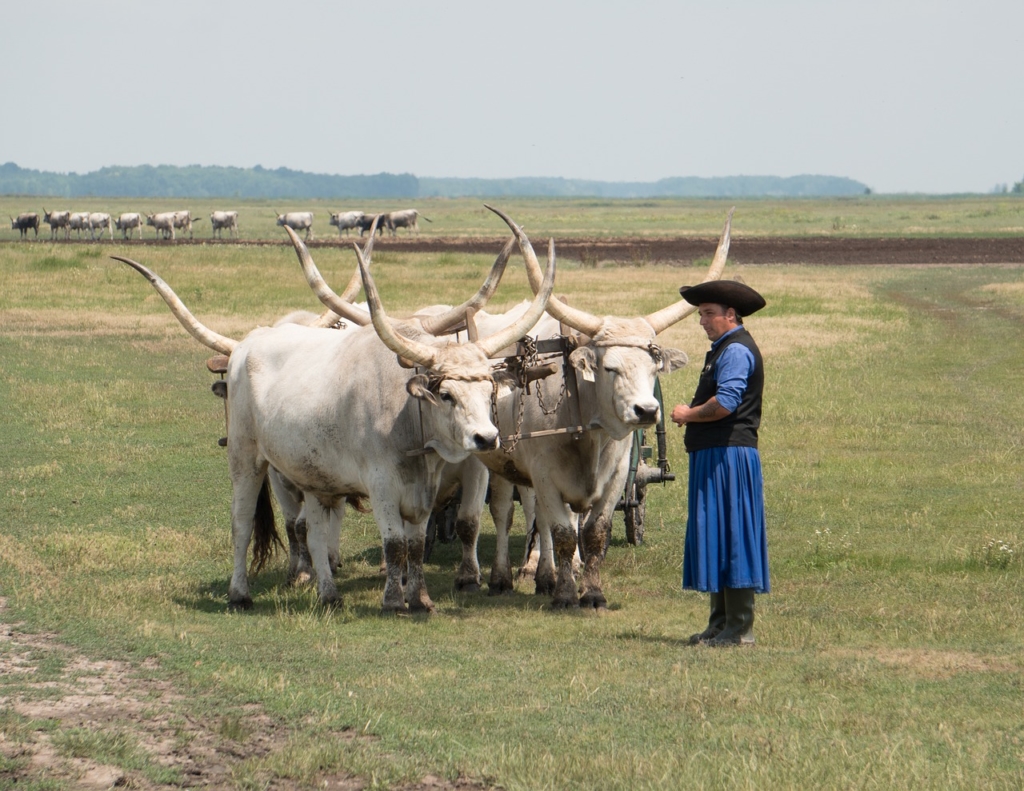
Hungarian herdsman with grey cattle
2. Part of the UNESCO World Heritage
On November 30, 1999, at the meeting of the UNESCO World Heritage Committee, the entire area of the Hortobágy National Park was added to the list of World Heritage Sites. This is special and noteworthy because the list currently includes over 1,000 sites, 779 of which received this title because of its cultural values, but only 83 of them can be classified as cultural landscapes, and only about 7 of them are connected to shepherding as a landscape shaping activity. The Hortobágy National Park is one of these seven. The stone slab – made from Dacite tuff from the Somoly quarry, the same material used to build the Nine-Hole Bridge – of the memorial plaque commemorating the park’s world heritage title is located in the village of Hortobágy. Both the sign and the bridge are worth a look if someone is visiting the park. The Hortobágy National Park is also one of many Hungaricums.
Photo: www.facebook,com/boszormenyi.sandor2
Photo: www.facebook.com/derencsenyiistvanphoto
Photo: www.facebook.com/derencsenyiistvanphoto
3. Not only the most famous but also the largest puszta
The Hortobágy National Park, consisting of 4 protected landscape areas and 19 independent nature reserves, is the largest grassy steppe not only in Hungary but also in Central Europe. It was once a grove-like steppe along the Tisza, but several factors led to how it is today. Wild grazing animals once roamed the land, but the complete deforestation and utilisation of grazing lands for domesticated animals played a decisive role in the formation of the present landscape.
4. The narrow-gauge railway across the national park
Uniquely, the Hortobágy National Park operates the only passenger narrow-gauge railway in Hungary around a fishpond. That pond, however, is Hungary’s largest artificially created fishpond, Lake Kondás. The approximately five-kilometre long narrow-gauge railway offers an unequalled view of the flora and fauna of the national park. You can find many animals in this region that are iconic to Hungary and almost all Hungarians will recognise.
The fauna includes Hungarian Grey cattle – which is also a Hungaricum –, Hortobágy Racka sheep, water buffalos, and one of the largest birds in Hungary, the Great bustard, just to name a few.
Photo: www.facebook.com/derencsenyiistvanphoto
Image:
www.facebook.com/HortobágyiRackajuhtartók/
Water buffalos bathing in mud
5. The ‘gémeskút’
If someone wanders into the Hortobágy National Park, it is impossible not to see a ‘gémeskút’. It can be referred to as a shadoof, a well pole, or a T-shaped sweep well; it is a crane-like tool with a lever mechanism used to lift water from a well. However, only a few people know that these tools – which are essential to the characteristic of the landscape – did not serve only one purpose. These T-shaped sweep wells were also used for limited communication. Based on the position of the lever of the well, people developed a signal system used by everyone in this area. The position of the lever meant several things: a ‘pandúr’ (here: an armed person who abused his authority) came, an official arrived, a woman stayed at the shepherd’s quarters, lunch was ready, the water in the well was not drinkable, the well was broken, drive the herd or the stud to the drinking place, there was an accident, etc. The wells thus functioned not only as a water source but also as an early communication system as they could be easily seen from miles away.
Farm at Hortobágy
Photo: https://www.facebook.com/pg/ilovehortobagy/photos