Subscribe to our social channels to get the latest news about Hungary!


Palmanova is not particularly well-known, even among tourists who regularly visit Italy. Even those who know the name of the city have only heard of the huge outlet center just outside the city, lying along the highway. Nevertheless, nowadays – as well as in 1615 – Hungarian soldiers played an important role at the edge of the city.
On 363 days of the year, Palmanova is a rather sleepy Italian town. Although the city is not far from the sea – Grado, the elegant resort with a rich historical background, lies less than 30 kilometers away in the south – and there are two World Heritage Sites in the immediate vicinity of the Palmanova – Aquileia’s Ancient Christian Basilica and Cividale di Friuli’s Lombard Temple –, there are in fact few visitors here.
According to Tropical Magazin, a few years ago, the city itself also possessed the World Heritage title as part of the “Venetian Works of Defense” sites. The existence of the city is due to Venice, since Palmanova lies on the edge of the former Republic of Venice, 100 kilometers in the south-west from the former capital. The border was not always peaceful. From the direction of the Austrian Dukedom in the north, the German emperor was threatening the state, while Turkish armies were coming from the east. Doge Leonardo Donato ordered the construction of a fortress in 1593. The most advanced urban planning and fortress design principles were taken into account at the time of construction. One of the best architects in the Republic, Marc’Antonio Martinego, led the construction.
He wanted to create a city that is not only a fortress, but is also the manifestation of the concept of the “ideal city”.
From above, the shape of the fortress town resembles a seven-pointed star, and each ray of the star signifies an Italian bastion. There are three gates to enter the city. The roads connecting the gates and bastions with the main square are settled evenly in radial arrangement. The central church, the palace of the governor and the other public buildings are on the main square, which seem rather oversized considering the scale of the city. Although Palmanova was a beautiful, elegant settlement that was considered modern in the past, it was not very attractive for some reason. Craftsmen and merchants did not want to settle down here, so after a while prisoners were forced to populate the city.
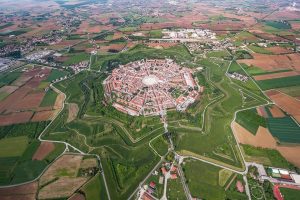
What once was a problem has now become an advantage. Palmanova did not extend beyond its original city walls. Nowadays, it is a small town with only 3300 inhabitants. Therefore, it practically remained as it once was imagined. If we were to see people dressed in baroque clothes on the streets instead of cars, we would feel like we were in the time of the Venetian Republic.
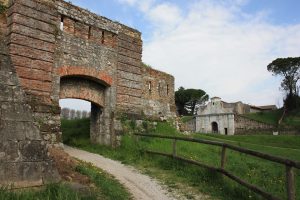
However, the question is not “whether” but “when”. A few days a year, the Republic of Venice moves back to Palmanova. On the first weekend of September, harsh military men fill the streets of the city with muskets on their shoulders and carrying long swords on their sides. They march under different flags, in a variety of colorful uniforms. In harmony with the tradition, the troops are accompanied by camp-followers, jesters and kitcheners. At the edge of city, where defense barriers still stand, hasty barricades are built and cannons are deployed between the bastions and the rampart, as if they were expecting a besieger army. Finally, the army arrives also in colorful uniforms, equipped with rifles, swords and canons. Instead of the winged lion of the republic, their flag carries the insignia of the imperial two-headed eagle. We can participate in an imaginary journey back in 1615 when the war that had trembled the founders of Palmanova broke out. The emperor invaded the territory of the Republic with great force. Naturally, there were many kinds of people among the imperial soldiers, such as Hungarian Herdsmen, Austrian heavy horsemen, Croats, Czechs, Imperial troops. However, the defenders were also diverse in terms of nationalities. Venice had allies, such as the Netherlands, and there were mercenaries there.