Subscribe to our social channels to get the latest news about Hungary!


Do you get more excited about visiting a place when you find out that it is part of the UNESCO World Heritage? Well, we definitely do, because the certification proves that the given site is of immense value. Listed below you find our 8 Hungarian World Heritage Sites and also the reasons why they are special 🙂
According to vilagorokseg.hu, Hungary joined the World Heritage Convention in 1985 and included the conditions in the Hungarian rule of law in the form of a statutory rule. Two years later, the World Heritage Committee decided on the first Hungarian sites to be added to the collection.
Since the summer of 2002, Hungary is the proud owner of 8 World Heritage sites. Out of them, seven belong to the ‘cultural’ category while one is listed in the ‘natural’ category. We share two of the sites (Caves of Aggtelek Karst and Slovak Karst, Fertő/ Neusiedlersee Cultural Landscape) with our neighbours, Slovakia and Austria.
Budapest, divided by the Danube into a steep and a flat side, and united by the delicate bridges, offers a unique panorama. The urban landscape on both sides of the river are rich in architectural wonders that represent the most important periods of history.
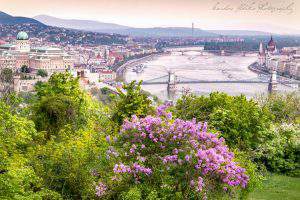
Budapest, united from three city parts in 1872-73, developed into a metropolis in fifty years, while guarding the structural characteristics of Buda and Pest. The pairing of the medieval-baroque Buda and the art nouveau Pest is simply enchanting.
Why is it a World Heritage Site?
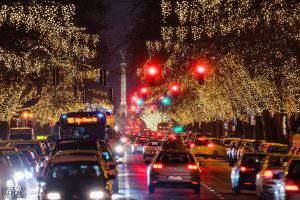
When designing and constructing the Andrássy Avenue and its surroundings, the most modern techniques were used. Moreover, the Hungarian capital receiving and passing on cultural impacts is a typical example of the Central European city development that joined periods of destruction and renewal.
Since when?
1987 (expanded in 2002)
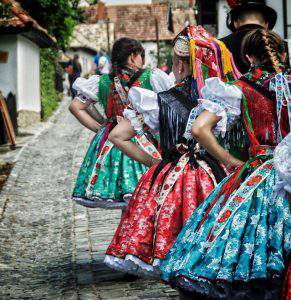
The consciously preserved Old Village of Hollókő, where traditions are still alive, is a Palóc settlement found in Nógrád County, North Hungary. The village evokes the beginning of the 20th century with a traditional architectural structure made up of 55 residential buildings and one church.
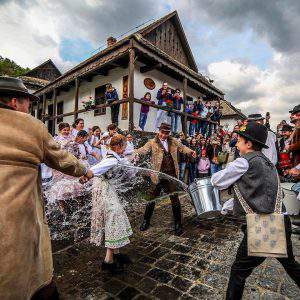
The historic settlement structure, the traditional Palóc architectural style and the use of material forms a harmonic unity with the natural environment. The 145 hectare World Heritage Site also includes the medieval castle ruins, the grazing-lands at the border and the close-by hills, forests and meadows.
Why is it a World Heritage Site?
It represents a culture that has become vulnerable due to the irreversible changes in the world. It is the example of traditional rural life, which is vanishing nowadays due to economic and social changes.
Since when?
1987
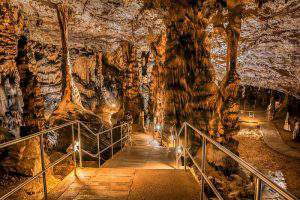
The caves and formations of the Aggtelek and Slovak Karst are of outstanding significance due to the exemplary richness of shapes, their complexity, relative intactness and the fact that they are concentrated in limited space. The system, which lies at the north-eastern border or Hungary and the south-eastern border of Slovakia, consists of more than 1,000 caves.
It is one of the most astonishing and complex examples of the mid-mountain karst formation in the moderate climate zone, while it is also rich in biological, geological and paleontological values.
Why is it a World Heritage Site?
The geological and geomorphological formations give evidence of thousands of millions of years of history. There are also traces signalling ice age climatic conditions, which is “well-documented” on a world scale.
Since when?
1995
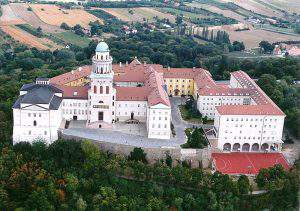
According to vilagorokseg.hu, the building complex of the abbey towers above the West Hungarian Pannon landscape on a hill, which was once called the “Sacred Mountain of Pannonia” (Mons Sacer Pannoniae). The Benedictine Order’s monastery was founded in 996. Hence it is the same age as Hungarian statehood.