Subscribe to our social channels to get the latest news about Hungary!


Lately, there has been a growing interest in Hungarian academic education on part of foreign students, most of them choosing universities sited in Budapest. In the following series, we will present some of the best Hungarian universities, hoping that during your summer trip to one of our exciting festivals, you’ve taken a deep interest in our culture and history.
Given that the number of foreign students (either visiting with Erasmus, or being full-term students) has quickly grown in the recent years, we’ve decided to give a short overview of why you should study at one of those Hungarian universities that are among the top and also offer courses in English or other widely spoken languages. After having discussed the Budapest University of Technology and Economics, Eötvös Loránd University, Corvinus University of Budapest, and Semmelweis University, we continue our series with institutions outside the capital city, such as the University of Debrecen.
photo: https://btk.unideb.huThe University of Debrecen came a long way since 1538 when the Calvinist College of Debrecen was founded. Since then, major changes happened to the College, transforming it to the current University of Debrecen. This makes the institution the oldest continuously operating one in Hungary.* In the early 20th century, the College slowly took up the structure of a university, and gained new names (of course the name was changed all the time, it always happens), was restructured with some faculties separated, others added to it. There is one point, however, when the institution’s transition to its current state began: in 1912 when the Hungarian Royal University was founded. Aside from theology, other subjects were taught, such as medicine, arts, and law.
During the communist era, a restructuring took place in 1949-50.
This meant that the faculty of theology was transferred back to the Calvinist College, the faculty of medicine was separated, and the teaching of western languages was completely shut down.
At the same time, the faculties dealing with Russian studies expanded greatly.
Finally, in on January 1st, 2000, the three universities of Hajdú-Bihar county (the University of Agriculture, Lajos Kossuth University, the Medical University – remember, it was separated in 1949/50) have merged, becoming the University of Debrecen.
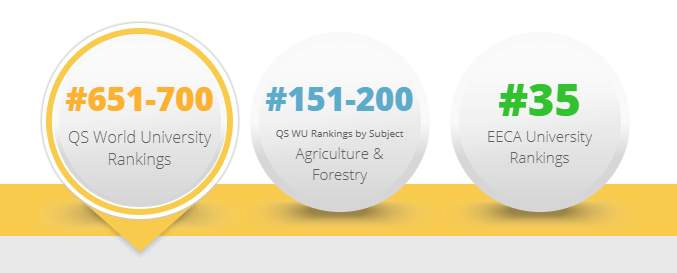
According to the latest rankings and the QS rankings, the University of Debrecen is the most popular higher education institution in Hungary among international students. Students choose UniDeb mainly because of the medical studies faculty. It is also
the most popular university outside Budapest.
If you choose to study at the University of Debrecen, then you won’t have to worry about finding research material or books to read, as it has the second largest library in the country.
The University of Debrecen’s student body is easily the biggest in Hungary (outside Budapest), as according to the latest data found on the university’s website, there are altogether 26994 students enrolled.
This institution offers two dual Bachelor’s programs too, in engineering and agricultural studies. What does this mean? Well, it means that apart from acquiring the theoretical knowledge needed in their chosen fields, students also have an opportunity to gain practical skills.
Since there is only one institution of higher education in the region, there are no separate universities for medicine, informatics, economy or law, arts, social sciences as we can see in the case of Budapest.
The University of Debrecen thus offers education in all major areas, at 14 faculties:
– Faculty of Agronomy
– Faculty of Arts
– Faculty of Dentistry
– Faculty of Economic Sciences
– Faculty of Medicine
– Faculty of Informatics
– Faculty of Law
– Faculty of Music
– Faculty of Pharmacy
– Faculty of Science and Technology
– Faculty of Public Health
– Faculty of Engineering
– Faculty of Child and Adult Education