Subscribe to our social channels to get the latest news about Hungary!


Playing cards has become one of the most popular activities in Hungary by the 1840s. The number of card-makers increased rapidly, and the games were often mentioned in contemporary works of literature and press. Playing cards was popular among aristocracy, soldiers, students and vagabonds. Most of the cards and games in Hungary were created based on games coming from Vienna. It gained a wider audience only in the second half of the 19th century.
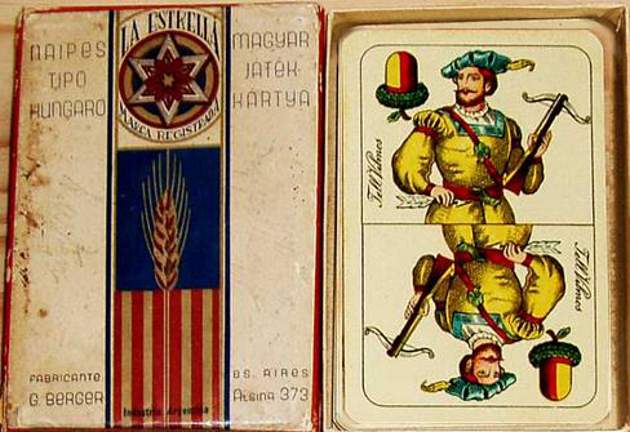
The German playing card deck consisting of 32 — sometimes 36 — cards is called “magyar kártya” (Hungarian card) in Hungary. The name of this set differs by regions. Hungarians used to call it “Swiss-German card”, “Swiss-Hungarian card” or “Helvetian card”, depending on the time period and geographical location. It was only called “Hungarian card” from a point on in the 20th century.
The peculiar fact is, though, that, while the cards actually depict Swiss folk heroes, this type of deck was never made or used in Switzerland.
The “Hungarian” playing card decks use the same four colors as their German predecessor from the 15th century: the hearts (“reds” in Hungarian), leaves (“greens”), bells (“pumpkins”) and acorns. The figures are the following: VII, VIII, IX, X, under-knave, over-knave, king and deuce. Some versions contain VI cards as well, adding four extra cards to the deck. Sometimes the six of bells functions as a Joker under the name “Welli”, as Wekerlekos.hu highlighted.
The Swiss folk heroes on the under-knaves and over-knaves. Photo: Wikimedia CommonsThe origin of the cards is hard to determine. Some people claim that it came from Switzerland, others named Germany as its place of origin. Even the famous American expert Hargrave stated that they are from Switzerland, but, as we mentioned earlier, he was proven wrong, according to epa.oszk.hu. It was also an interesting question why a Hungarian card set depicts Swiss folk heroes.