Subscribe to our social channels to get the latest news about Hungary!


BKK is pleased to announce that the tendering process for the design build and five-year operation of an automated fare collection system for public transport in the Hungarian capital has been successfully completed, bkk.hu reports.
 After introductory remarks by the Mayor of Budapest Mr István Tarlós, the Contract Agreement was signed by Mr Dávid Vitézy, CEO of BKK Centre for Budapest Transport and Mr Matthias Augustyniak, the Managing Director representing Scheidt&Bachmann GmbH of Germany who are the successful tenderer as one of the leading companies in automated fare collection systems worldwide, the company will design, build and operate the system for a total contract value of EUR 91 million. The project will transform public transport in Budapest by providing a high level of sales service and state of the art tariff scheme to city-dwellers, commuters from the metropolitan area and tourists. Budapest’s fare collection scheme will be world class and on a par with those in cities such as London, Chicago and Hong Kong. The project is jointly funded by the European Bank for Reconstruction and Development and the Municipality of Budapest and will be implemented in several phases between 2015 and 2017.
During the two-stage tender process 79 companies showed interest. Eight companies applied for the prequalification, out of which six companies met the criteria. As a result of one withdrawal and a formation of a consortium, four companies submitted a detailed technical tender and then a legally binding offer in the second stage. The winning tenderer is Scheidt&Bachmann with the most competitive offer Under the Contract Agreement concluded today, the winning tenderer will be responsible for building the revenue system, the creation of the required IT background, the installation of the automatic access gates at metro and suburban railway stations and the implementation of all the necessary elements of the validation and revenue protection systems.
As part of the programme of Mayor István Tarlós, the General Assembly of the Municipality of Budapest assigned BKK Centre for Budapest Transport to prepare the project. The work had to be started from scratch as no usable preliminary preparation was available. On the basis of the concept approved by the General Assembly of Budapest in early 2012, BKK first secured the financing and then conducted the tendering process. Hungary’s largest public transport network used by the most customers has lacked a modern, easy-to-use ticketing system that is able to adapt to customers’ demands flexibly and innovatively. In the past decades, similar systems were introduced in several cities around the world, now finally Budapest can also join their league. Although promised for more than 20 years, the substantial preparation began only in 2011.
As a result of the introduction of an automated fare collection system, public transport service levels will significantly increase. The tariff scheme will be enhanced by the introduction of time-based tickets, while sales services offered by the new ticket vending machines and customer service centres will be supported by online and mobile phone based purchasing options. In addition to that, revenue protection will also be reformed. As a result of these changes paper-based passes and tickets will soon disappear from Budapest.
Partners of BKK, the transport organiser of Budapest, in the project implementation will be Scheidt&Bachmann from Germany, one of the leading European companies of automated fare collection systems and its subcontractor Octopus Transactions Ltd. from Hong Kong. According to the Contract Agreement, the winning company of the tender process which started in the summer of 2013 will not only design and build the system, but also operate it for five years. Scheidt&Bachmann is not an unknown actor in the public transport of Budapest: the Mönchengladbach-based company founded in 1872 supplied – as a subcontractor – the new ticket vending machines of which more than 200 are already operating successfully in the capital and in surrounding towns.
Following the signing of the Contract Agreement, the detailed technological and architectural design phase of the system will begin and last for several months. After a pilot period, issuance of cards for non paying riders can take place. It will be followed by the pass products while time-based tickets and daily capping will also be introduced as a result of the already installed automatic access gates and on-board validators. As part of the implementation, we will develop a new central system while new validators will be installed on every surface vehicle and all metro and designated suburban railway stations will be gated. The current paper-based tickets and passes will be finally phased out by 2017. In the transition period the two systems will operate simultaneously.
As a result of the Loan Agreement concluded in September 2013, the introduction of an Automated Fare Collection system in Budapest is secured by the European Bank for Reconstruction and Development (EBRD) in the amount of EUR 54.5 million. The Municipality of Budapest provided BKK HUF 5.3 billion according to the Development Agreement concluded in April 2013.
The tendering process of the project proceeded according to Procurement Policies and Rules of EBRD. Six out of eight companies meet the criteria of the prequalification formed by BKK and approved by the EBRD. Following that in March 2014, prequalified tenderers submitted their technical bids containing key technical and business requirements. Based on the submitted tender documents and the clarification meetings, BKK has prepared the final version of the technical requirements to which the tenderers submitted their final technical and commercial bid. All of the prequalified tenderers, namely the contract award winner German company Scheidt&Bachmann, LG CNS from South Korea, Cubic from the United Kingdom and the Thales and Xerox consortium from France have submitted valid bids.
For the price of the implementation and the five-year operating period, Scheidt&Bachmann offered EUR 91 million, second-placed LG offered EUR 112 million, Cubic came in third with EUR 128 million while Thales-Xerox offered a price of EUR 168 million. Overall, the procedure ended with a clear winner in a strong competitive environment with the lowest-priced, technically qualified offer.
On the basis of the submitted technical and price bids, the international market has confirmed the concept and price calculation of BKK both regarding the costs of implementation and operation as the winning bid is below the initial calculated costs. As a result of that, there are sufficient funds for the implementation and operation of the project.
The basis of the AFC operation is the central system which registers the cards and travel media, product purchase, balance top-ups, calculates prices and related financial settlements and supports the new, integrated sales channels. The supplier’s responsibilities are to design, implement, install, configure and test all of the software and hardware elements of the system and, finally, to hand over the system for operation.
According to BKK’s calculations, 1.5 million personalised and anonymous smart cards will be issued for BKK’s regular customers, with a further circa 9 million smart papers for occasional travellers and tourists (visitors staying in Budapest for a short period of time). In order to achieve this, a new online sales channel will be developed, Ticket Vending Machines will be integrated into the AFC system, sales will be offered via BKK’s Call Centres and BKK’s Customer Service Centres will be equipped with card personalisation devices.
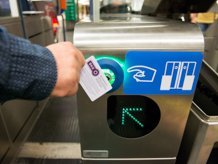
The revenue protection system will also be renewed. Approximately 800 automated access gates will be installed at metro stations and designated suburban railway stations while ticket inspectors will be provided with over 600 new hand-held devices to help them check the validity of cards more easily and quickly. The supplier will be to tasked to produce installation plans for every station, obtain the necessary permissions from authorities and to produce, deliver and implement the access gates.
Part of the system will be circa 10 thousand new validators to be installed on 2,500 vehicles (buses, trolleybuses and trams) and 450 validators to be installed at suburban railway stations which cannot be enclosed by gates.
Building on the experience gained in the deployment of the FUTÁR system, it is expected that the preparation of vehicles for the AFC system will probably be the most time-consuming phase of the project. This is the main reason why the project will take three years. However the currently-used paper-based tickets will disappear entirely at the end of this process.
Changes resulting from the introduction of Automated Fare Collection system (AFC)
Smart cards, online purchasing opportunities, acceptance of new student IDs are coming
As a result of the development, paper-based passes and tickets will be replaced by a plastic card with a chip. Customers can choose to have them personalised or anonymous.
Personalised travel card with the customer’s name and photo on it will not be transferable. Any discounted products (free of charge, pensioners’ discount etc.) and passes can only be purchased if the customer is in possession of a personalised plastic card. By contrast anonymous cards will be issued without a photo or name; they will only contain a card number and can be freely transferred to other persons.. The PAYG balance of these anonymous cards entitles the owner to purchase ticket-type products only.


I remember the test project in Corvin Metro station:
http://www.szeretlekmagyarorszag.hu/wp-content/uploads/2013/06/470_cm4.jpg
It looked very idiotic to see the gates with all the controllers; and it didn’t work well.