Subscribe to our social channels to get the latest news about Hungary!


The first metro line in Budapest (officially known as Millennium Underground Railway) is the oldest in Continental Europe and second oldest in the world after London underground.
The first train ran here in 1896 when Hungary celebrated its Millenium (the thousandth anniversary of the foundation of the Hungarian state): actually it was built exactly for this reason and in order to connect city with the park and castle which were not parts of the city at that time.
This line is not deep and mostly goes under Andrássy Avenue (which is the main avenue of the city, with lots of sightseeing and which is often compared to The Avenue des ChampsÉlysées).
So, lets have a small journey and find out some nice places, at the same time learning about some personalities and events which played some role in Hungary and its history.
We are going to start from Vörösmarty tér. This station is on the square where you can always find some fair, where Vaci street begins (the main shopping street for tourists and not only). In the center of the square there is monument for Mihály Vörösmarty. He was Hungarian poet, writer and translator of 19th century. All his works are full of heroism and patriotic feelings. One of Mihály Vörösmarty`s poem is Appeal (Szózat) it is the most famous work of this person, which nowadays can be heard during national holidays. Here are some lines:
Oh, Magyar, keep immovably
your native country’s trust,
for it has borne you, and at death
will consecrate your dust!
No other spot in all the world
can touch your heart as home
—let fortune bless or fortune curse,
from hence you shall not roam! As he lived during the Revolution of 1848 he supported it and had been a Member of Parliament during this time. As a professional lawyer he also had been a judge in Supreme Court of Hungary.
The next stop is Deák Ferenc tér. Deák Ferenc was Hungarian politician of 19th century. He can be called as the father of AustroHungarian Compromise of 1867. Hungary received internal independence, but there were left some issues which can be better realized by both countries together on an equal footing. For his wisdom and diplomatic qualities he was called “Hungarian Wiseman”.
And we are going further and our next stop is right in the beginning of Andrássy Avenue and Bajcsy Zsilinszky street Bajcsy Zsilinszky út. Here you can find St. Stephen’s Basilica. The street is named after Hungarian politician, journalist and one of the members of antifascist movement of the beginning of 20th century Endre Bajcsy Zsilinszky. He was one of the organizers of National Radical Party speaking against war with USSR, also was famous as organizer of the antifascist Hungarian Front (1944) but very soon was captured and executed by the Nyilaskereszt part (Arrow Cross Party) the fascist party which was active in Hungary during 1938-1945.
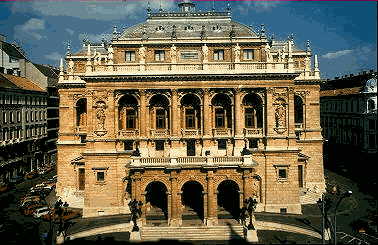 Photo: www.operabudapest.net
Opera as we can guess from the station`s name here can be found Hungarian State Opera House. The Opera was opened in 1884 and the building was designed by famous architect Miklós Ybl. It was built in neoRenaissance style, with elements of Baroque. This Opera House is considered as one of the best in beauty and the quality of acoustics in the world. At the same time Opera House is the main stage for Hungarian Ballet.
Octogon the square got such name because of its eight angles. It is important junction point of public transportation of Pest. Very close you can find Liszt Ferenc Square which is very cozy with lots of trees, flowerbeds and cafes.


