Subscribe to our social channels to get the latest news about Hungary!


Have you ever tried to engage in the Hungarian alphabet, but gave up when you got to ‘dz’ and ‘dzs’? Have you ever tried to pronounce ‘gy’, ‘ny’, ‘ty’, but they just didn’t seem to sound right? Well, our alphabet can seem as tricky as our language on the whole, but we are here to bring you some fun facts and learning cards that might help you 🙂
Keep in mind that we are not linguists in any way, we’re just as dazzled by the curiosities of the Hungarian language as foreigners are. So this series doesn’t aim to explain the etymology of words, it’s more of a fun take on our language. We try to bring Hungarian closer to you with witty learning cards made by Daily magyar, a language-enthusiast person, whose posts give an insight into the complexity of the Hungarian grammar. But don’t worry, it’s all done in an easy-going way, so that it can make learning fun.
Let’s focus on the Hungarian alphabet now. You’re most likely to get in touch with it early on if you start learning the language. We have 44 letters, which might seem like a lot at first, but you’ll understand more or less how they work with time.
A fundamental characteristic is that we express consonants that don’t exist in the Latin alphabet with the combination of several letters of the Latin alphabet, while some of our vowels have diacritic versions. Something that poses a problem to foreigners is that we have unique double letters with special pronunciation. For instance, in some cases, the letter ‘y’ is added to ‘g’, ‘l’, ‘n’ and ‘t’, thus softening the pronunciation. Another letter that has a modifier role is ‘s’, which is added to ‘c’ and ‘z’.
abc; abécé – alphabet
betűrend
1) alphabet
2) alphabetical order
[Literally: letter-order]
betűrendi – alphabetic; alphabetical
betűrendes – alphabetic; alphabetical
betűrendben – alphabetically
betűrendbe szedni – to alphabetize
betű – letter; character
rend
1) order; sort
2) rank; rate
This video will help you with the pronunciation of our letters:
https://www.youtube.com/watch?v=JwtwZTRDvYI
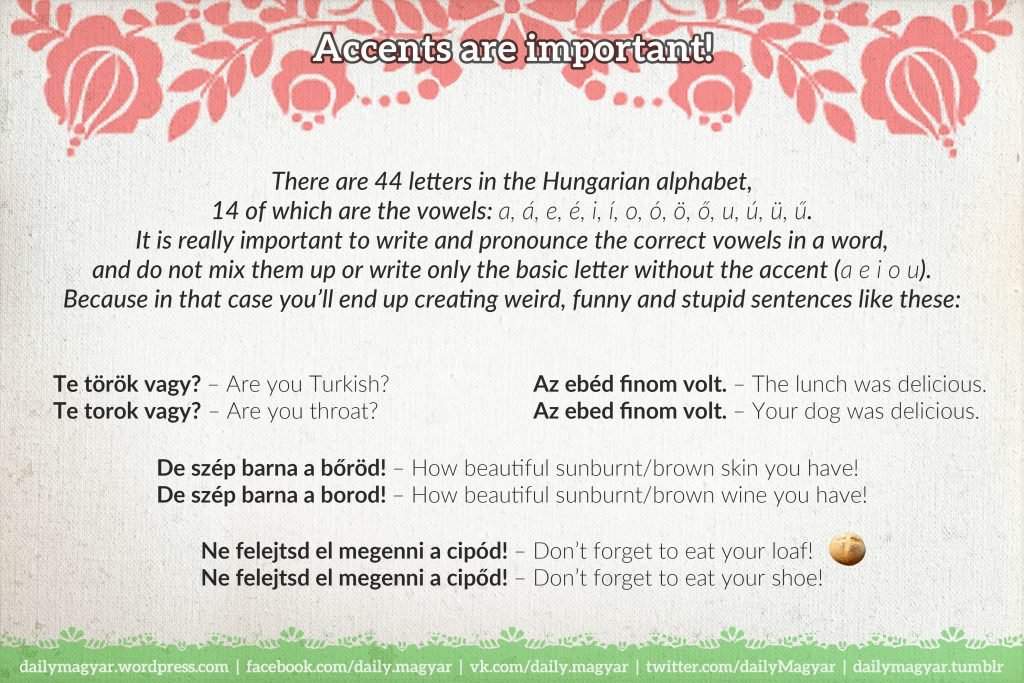
Something else that you might find weird is that we have vowels that no other languages have. Some of our vowels have accents, which can make big differences in the meaning of words, so you should try to remember them, otherwise you might end up in funny situations.
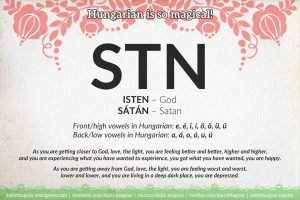
The next photo demonstrates the difference between front/high vowels and back/low vowels, which is the basic grouping of Hungarian vowels: